
Astronomy & Planetary Perspective
Saturn’s Rings: Viewing Angle and Sunlight
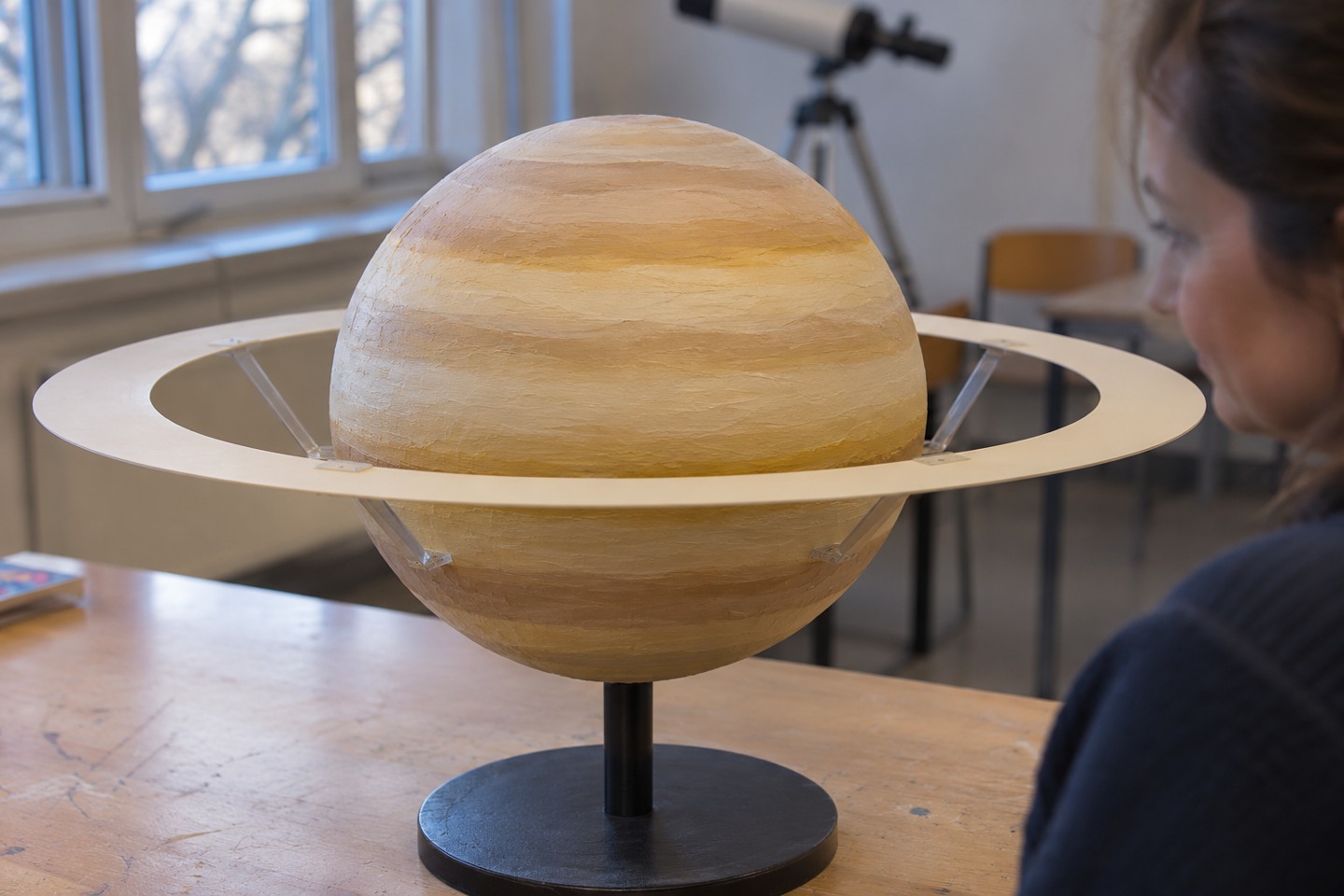
Saturn is often drawn with a broad, unmistakable ring. That familiar outline can make a narrow view look incomplete, as though part of the planet has gone missing. Yet a wide structure can present a remarkably small profile when we look along its edge. Saturn’s changing appearance offers a particularly rewarding way to explore that geometry. It also introduces a second question that a picture alone can conceal. Where is the light coming from? Separating the observer’s position from the Sun’s illumination helps explain both the graceful changes visible from Earth and some of the discoveries made close to the rings.
A ring has a face and an edge
Imagine a thin circular annulus, the flat shape left after removing a smaller circle from the middle of a larger one. From above, its broad face is easy to see. Lower your eye towards its plane and the opening becomes a narrower ellipse. At eye level, the same object presents little more than an edge.
The object has retained its width throughout this exercise. What changed was its projected shape in your view. This is why a photograph can show a dramatic change without implying an equally dramatic change in the material being photographed.
NASA’s Hubble sequence from 2018 to 2024 gives this idea an astronomical setting. The images show the apparent opening of Saturn’s rings changing relative to Earth as Saturn travels around the Sun. NASA describes an approximately fifteen-year interval between edge-on presentations. The sequence is a record of those specified years; it should be read with its dates attached.
Before comparing any two Saturn pictures, ask whether they depict the same viewing geometry. A broad ring in one and a fine line in another can be a valuable comparison precisely because the observer’s line of sight has changed.
The planet’s long year sets the background
NASA’s Saturn facts give an orbital period of about 29.4 Earth years and an axial tilt of approximately 26.7 degrees. Saturn consequently experiences seasons over a much longer year than ours. Its main rings orbit in its equatorial plane, so their orientation is part of the geometry we observe as the planet moves through that year.
Earth is moving too. A ring-plane crossing as seen from Earth concerns the relationship between Earth’s location and the plane of Saturn’s rings. The familiar long seasonal rhythm is useful context, but a rough interval is insufficient for scheduling a particular observation. Exact circumstances belong to a dated calculation and a stated observing location.
For that reason, this story explains the geometry rather than providing a current observing timetable. An archival picture with a dramatic caption cannot tell you the best time to point a telescope tonight. Keep a source’s observation date separate from the date its webpage was updated.
The distinction is especially helpful when an old photograph circulates again. “Edge-on” describes a relationship between a line of sight and a plane. It needs an observer and a date before it becomes a claim about a particular view.
Move the observer while keeping the model still
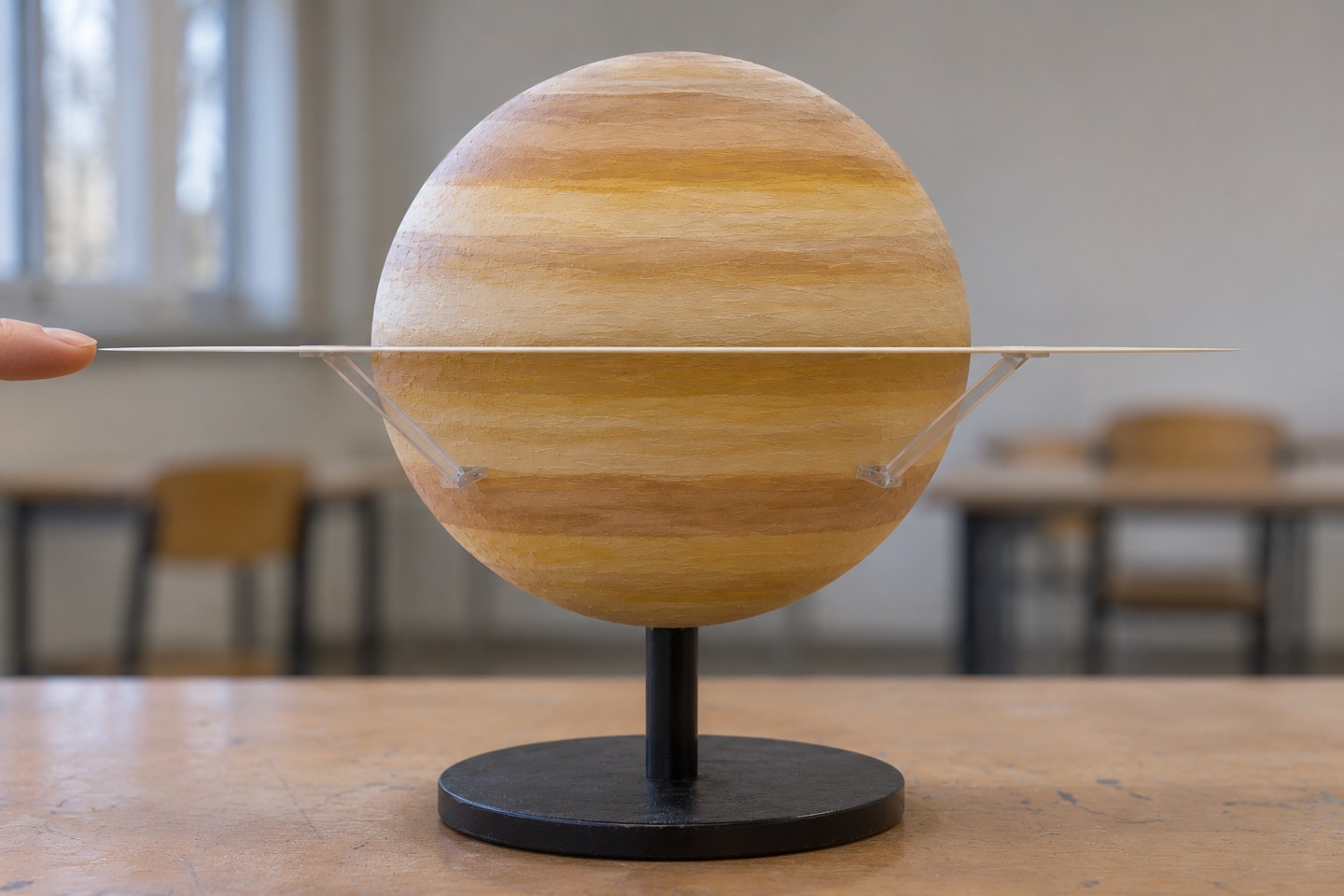
A simple classroom demonstration lets you isolate that relationship. Use a flat ring shape mounted around a ball, or examine a ring-shaped object already supported at a convenient height. Leave the object fixed and observe from above its plane. Then move your viewpoint down towards the edge, keeping the light source in the same place.
Notice which parts of the annulus remain visible. Near edge-on, a substantial physical width can occupy a very narrow band in the picture. The globe hides the rear portion, while the front portion can cross its visible face. A photograph from each position records an effect of viewpoint.
Describe each image before assigning a date or astronomical angle to it. “Viewed from above the plane” and “viewed near the plane” are sufficient labels for this demonstration. A handmade model, an unmeasured camera position and a classroom window do not supply the precision needed to reconstruct a Hubble observation.
The two original illustrations here represent that simplified exercise. Their rigid rings and support struts belong to imagined teaching models. Real ring particles follow orbits; they are not attached to Saturn by a solid framework.
The Sun supplies a different alignment
Now leave your eye in one place and consider moving the light source. You have changed illumination while retaining the observer’s view. That is a different operation from lowering your eye towards the plane.
NASA’s account of Cassini’s ring discoveries describes Saturn’s equinox, when sunlight reaches the rings edge-on. Cassini observed the 2009 equinox from Saturn orbit. Low-angle illumination produced long shadows that made raised ring features easier to investigate. NASA also reports unusually low ring temperatures during that alignment.
Those observations concern the Sun’s direction relative to the ring plane. An Earth-based ring-plane crossing concerns our viewing direction. The Sun and Earth occupy different places, so the two descriptions should retain their respective reference points even when they are discussed within the same season.
A classroom model helps make the question tangible. An object’s broad face can remain visible to you while a light shines nearly along its surface. Features that cast small shadows under overhead illumination can produce longer shadows when lit at a shallow angle. The source of illumination has changed what becomes conspicuous.
A smooth outline contains a complicated system
The neat annulus is a useful simplification, but it leaves out much of what gives Saturn’s rings scientific interest. NASA describes a system made of many particles, with different ring regions and gaps. A model’s continuous surface represents a plane; it does not reproduce the particles, their motion or the varying properties of the real rings.
Cassini’s measurements and images add that missing physical complexity. Its changing illumination revealed structure that an idealized flat shape would conceal. The lesson of the model is therefore limited and useful. It explains why a viewing angle can narrow an outline. Evidence about actual ring structure comes from observations and measurements.
When you see a composite picture showing several Saturns, read how the images were assembled. Check the dates, instrument and processing information. Equal sizes on the page may be a presentation choice. Brightness or colour differences also require their own explanation, rather than being automatically assigned to the ring-opening angle.
One productive comparison uses only a single question at first. Are the rings more open to the viewer in this image? Answering that question clearly is better than asking one changing outline to explain every difference between two photographs.
What a changing view can offer reflection
A reader drawn to planetary symbolism may find a useful personal exercise here. Choose an unfinished commitment and describe it from two positions. From the perspective of the person doing the work, what is difficult? From the perspective of someone waiting for it, what is visible? Keep the underlying task fixed while changing the viewpoint.
This is a suggested metaphor, rather than an astronomical prediction. The rings’ appearance does not determine the outcome of the commitment. The exercise becomes useful when the second description reveals information you can act on, such as an unclear deadline or an update that has not been communicated.
Then ask an illumination question. Which details become easier to notice when you examine the task under a different condition, perhaps after obtaining missing information? A changed perspective and new evidence can both alter understanding, but they contribute in different ways. Name what actually changed.
Keep the geometry with the image
Saturn’s ringed outline is more interesting when allowed to vary. A narrow presentation can show how large structures occupy little apparent height. A seasonal change in sunlight can expose features that another illumination hides. Together they make a case for reading an image with its observing circumstances.
Keep three questions beside the next Saturn photograph you examine. Where was the observer? When was the observation made? How was the ring plane illuminated? The answers connect an arresting picture with an explanation, and give its beauty a physical context.
Sources and further reading
The linked NASA Hubble sequence, Saturn facts and Cassini ring resources support the astronomical discussion. The classroom demonstration and reflective prompts are original editorial suggestions. Both images are original AI-generated photographic-style illustrations of simplified teaching models, not photographs of Saturn or measured reconstructions of a spacecraft view. Continue with Venus’s phase and apparent brightness or retrograde motion and the observer’s viewpoint, or browse News & Stories.