
Astrology & Astronomy
Retrograde Motion: What Changes When the Observer Moves?
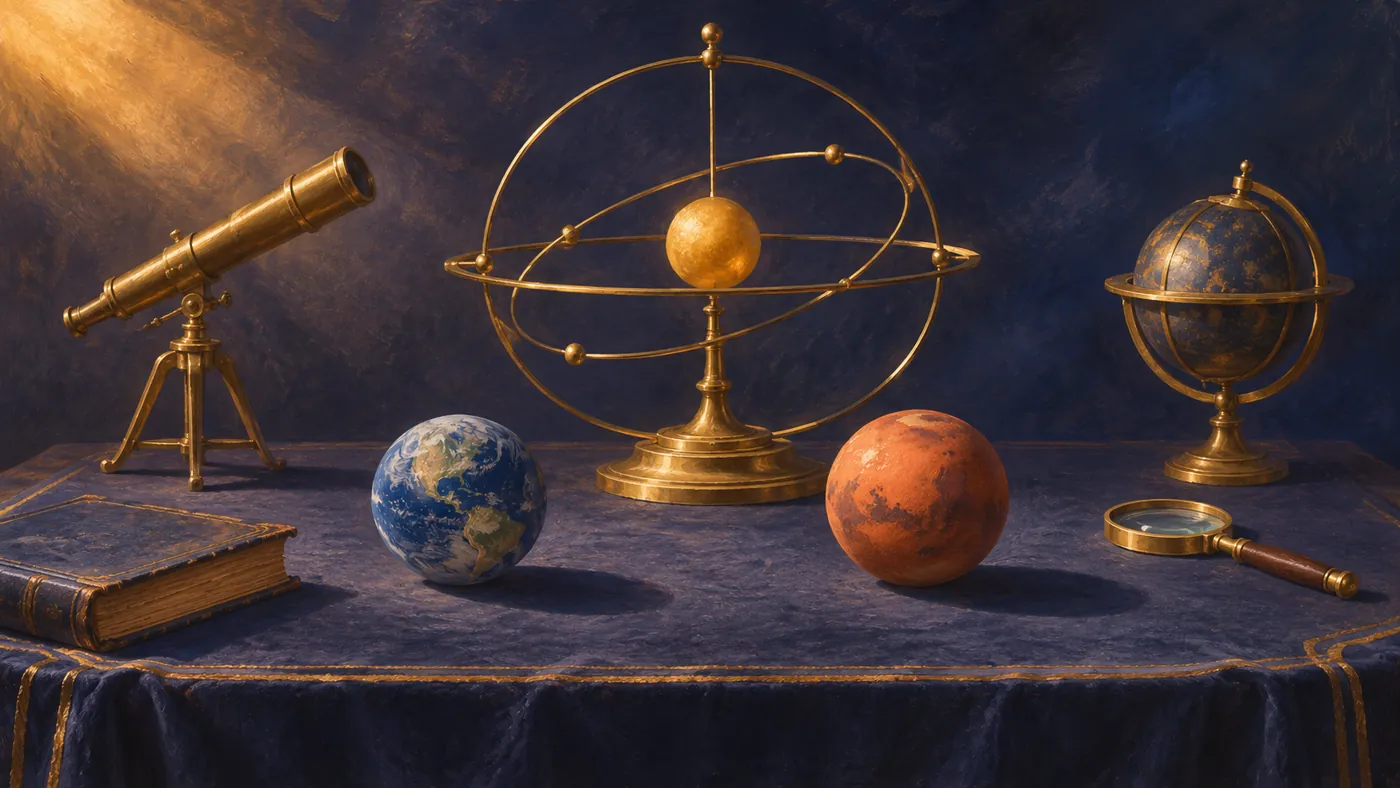
A planet that seems to retrace its steps makes a powerful image. It can suggest reconsideration, delay or a return to unfinished work. Before giving that image a personal meaning, however, there is a wonderfully concrete question to ask: what is actually moving backwards? Retrograde motion becomes clearer when we follow the observer as carefully as the planet. The result is a lesson in perspective that can enrich an interest in astrology while keeping astronomical evidence and symbolic interpretation distinct.
Backwards against which background?
In this article, retrograde means a temporary reversal of a planet’s apparent progress against the distant stars as viewed from Earth. NASA’s StarChild explanation distinguishes this change of appearance from a planet physically reversing its orbit around the Sun. That distinction is the foundation of the whole story: an observed direction on the sky and a direction of travel through space are different descriptions.
There is also more than one kind of apparent movement to keep track of. Watching an object cross the sky over an evening is not the same exercise as comparing its position among stars on successive dates. A useful question is therefore not simply “Which way did it go?” but “What did I compare it with, and over what interval?” Those extra words prevent two different observations from being treated as a contradiction.
A deliberately simple analogy is a view from a moving train. A nearby train can seem to slide backwards when your train passes it, even though both are travelling forwards along their tracks. The analogy is incomplete because planetary orbits curve, but it makes one essential point: your own motion belongs in the explanation.
Earth is part of the picture
For a planet outside Earth’s orbit, such as Mars, Earth’s overtaking motion helps produce the apparent reversal. NASA’s archived lesson on the planets explains how the viewing direction changes as Earth passes an outer planet. It also distinguishes Mercury and Venus: these inner planets travel inside Earth’s orbit, so the geometry involves their overtaking Earth. The same casual phrase, “going backwards,” can conceal different orbital arrangements.
Think of a camera mounted on a moving platform rather than a spectator standing outside the Solar System. Each observation points from that platform toward another moving object. Plotting those directions against a distant background produces a path that need not resemble the object’s orbit. A loop on a sky map is therefore not a loop that Mars has suddenly steered through in space.
This is why a picture needs a caption. A view from above the orbital plane, a chart of positions seen from Earth and a photograph made on one night answer different questions. Without that context, an elegant illustration can accidentally teach the wrong motion. Our generated artwork is conceptual; it is not a calculated orbit plot or an observing chart.
A real photographic sequence
NASA’s Astronomy Picture of the Day feature “Mars in the Loop,” published on 30 May 2025, offers a documented example. Tunç Tezel’s composite brings together photographs taken from 19 September 2024 to 18 May 2025, at weather-dependent intervals of five to nine days. The sequence traces Mars against Gemini and Cancer. Its long span is part of the evidence, rather than a decorative detail.
A composite like this should not be mistaken for a single photograph containing many planets. The repeated red points represent one planet observed at different times. Aligning the background stars makes the change in its apparent position visible. The method turns a slow process into a pattern that a reader can inspect at once.
Notice how much stronger this is than an unexplained loop drawn beside a headline. The record identifies the photographer, the dates and the construction of the image. Those details allow us to ask what was observed. They still do not turn the sky pattern into evidence that a conversation, purchase or relationship on Earth must follow a particular course.

Why a date alone is not a full calculation
If a claim gives an exact moment when a planet “stations,” ask which coordinate is being followed. A station is a turning point in apparent motion in a specified coordinate; it does not mean that the planet has stopped travelling through space. A day printed on a calendar is the abbreviated result of choices about measurement and presentation.
The JPL Horizons manual shows what a reproducible astronomical setup involves. Its ephemerides can be customized by target, observing location, time and reference frame, with different positional quantities and time scales available. For a precise comparison, save the settings with the output. Record whether the observing center is Earth’s center or a location on its surface, and identify the coordinate quantity rather than leaving it implicit.
Timezone is another separate choice. The same instant can fall on different calendar dates in different places. Two summaries should therefore be compared as instants with stated time standards before one is declared wrong. This story supplies no current retrograde timetable; its purpose is to explain how to read such a timetable responsibly. Our earlier article on tropical, sidereal and constellation maps explores a related problem: the reference system must be named before results can be compared.
From an observation to a personal metaphor
A reader interested in astrology may choose to use apparent reversal as a prompt to reconsider something. That is an interpretive choice, and its status should remain visible. “I am using this image to review a draft” is a statement about a chosen practice. “This planet will make my project fail” is a prediction about an external outcome. The first sentence does not establish the second.
Here is an original reflective exercise that needs no forecast. Choose one unfinished task and describe its present difficulty in ordinary terms. Perhaps the brief is unclear, a dependency is missing or a decision has not been documented. Then ask whether revisiting an earlier step could help. Keep the reason for your next action beside it: clarification, missing information or a practical constraint.
For an invented example, suppose a designer feels stuck on a brochure. Revisiting the client’s audience might reveal that the layout was solving the wrong problem. The useful result is the clarified brief. The planet has supplied a metaphor for returning, while the decision can be explained through the work itself. This preserves the imaginative value of the exercise without claiming that an astronomical direction caused the difficulty.
A better way to read the next headline
When another retrograde headline appears, separate three questions. What is the measurable sky motion? How was its timing calculated? What meaning is the writer choosing to attach? A source can be strong on one question and silent on another. A precise ephemeris establishes positions; it does not, by itself, validate a personal prediction.
Retrograde motion is compelling because it makes the observer impossible to ignore. Earth participates in the changing view, and our language participates in the story we tell about it. Understanding the geometry leaves room for wonder: a small red point can record the interaction of two moving worlds. A symbolic reading can begin there, provided it remains an interpretation whose claims we can still examine.
Sources and further reading
The four linked NASA and JPL resources support the orbital explanation, documented photographic example and calculation discussion. The train analogy, reading procedure and designer exercise are original editorial explanations. The two illustrations are newly generated conceptual artwork. For another look at measurement and meaning, read our story on the astrolabe, or explore our Tarot Guides for reflective card-reading practices.