Astronomy & Planetary Perspective
Why Venus Can Be Brightest as a Crescent
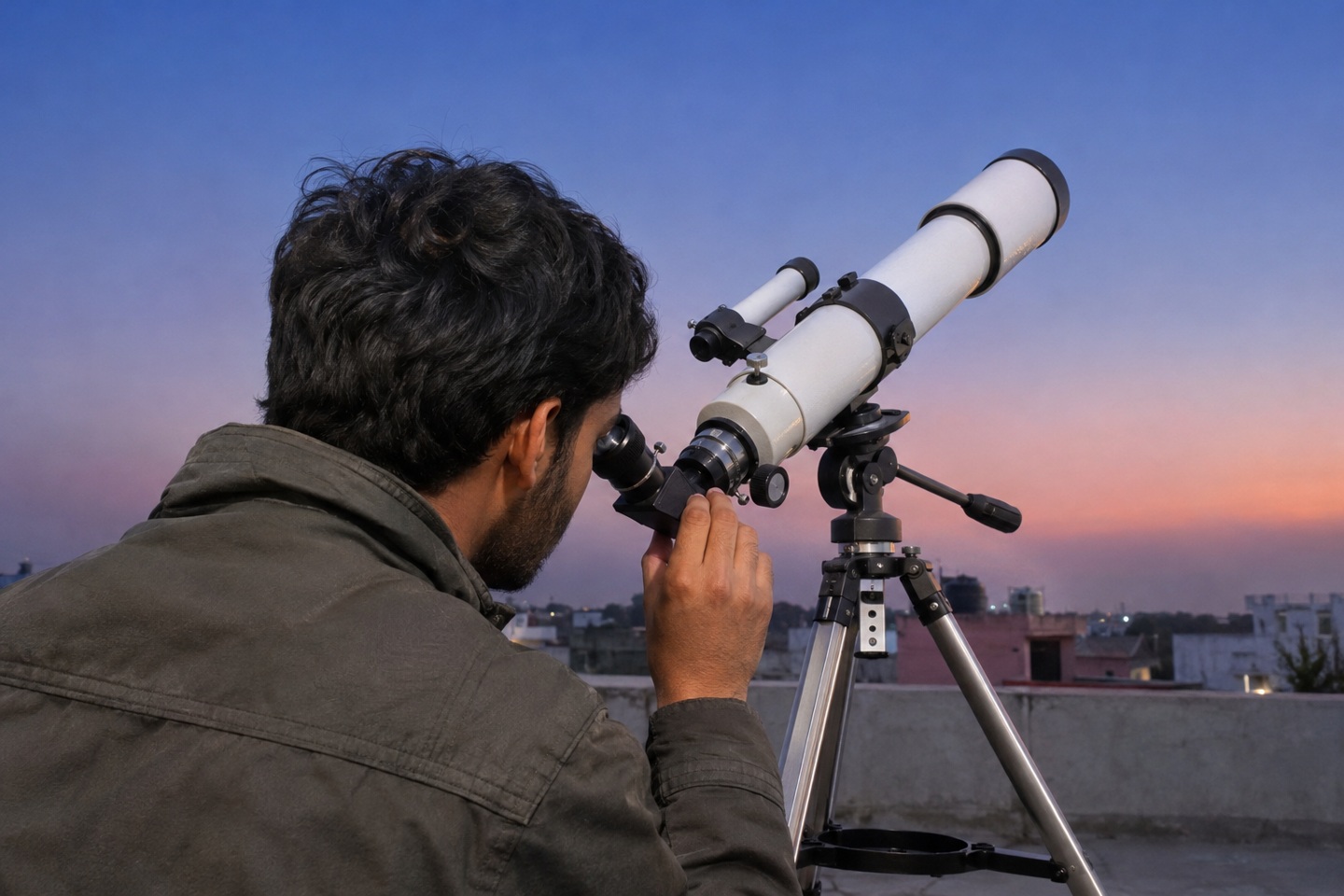
A bright point can hide a surprisingly narrow crescent. Venus is a useful challenge to the assumption that a fuller-looking object must always appear brighter. Its changing appearance brings together three questions that a single picture can blur: how much of the visible disk is sunlit, how large that disk appears, and how much light reaches us. Understanding the differences makes a telescope view more interesting and keeps symbolic associations separate from measurements.
A percentage does not describe the whole view
Phase concerns the illuminated portion of the disk we see. Apparent size concerns how much of our field of view that disk occupies. Two objects can have the same illuminated fraction but very different apparent sizes. Conversely, a large crescent can present a substantial bright area even though much of its visible disk is dark.
NASA’s January 8, 2024 presentation of the phases of Venus describes the relationship clearly: on the far side of the Sun from Earth, Venus looks smaller and nearer full; when the planets are on the same side, Venus can look larger and crescent-shaped. The planet has not physically swollen. Its changing distance and the viewing geometry change what the observer sees.
This is why an attractive row of planetary images needs its presentation rules. Were all the pictures displayed at the same angular scale, or resized to make their outlines equally large? Equal-sized thumbnails can be useful for comparing shapes, but they conceal the change in apparent diameter. Before comparing brightness, ask what the editor has held constant.
Why a crescent can outshine a fuller disk
In its February 2025 skywatching explanation, NASA connects Venus’s brilliance during a crescent phase to its smaller distance from Earth. The increased apparent size can more than compensate for the reduced illuminated fraction. That dated guide supplies an explanation of the geometry; its observing dates are not a forecast for November 2026.
A simple paper exercise helps separate the variables. Draw two circles, one with twice the diameter of the other. Its total disk area is four times as large. If a quarter of that larger disk is illuminated, its projected illuminated area equals the whole area of the smaller circle. This is an invented geometrical comparison, not a pair of measured Venus observations or a brightness calculation.
The limitation matters. Equal projected areas need not send equal amounts of light toward an observer. Reflection depends on the material and lighting angle, and an actual planetary calculation needs more than a fraction and a diameter. The exercise only shows why a percentage cannot answer the brightness question on its own.
Nor should “brightest as a crescent” become “the thinner the better.” As the geometry changes further, other effects change too. A useful general explanation does not authorize an unlimited rule or a maximum-brightness date pulled from the appearance of one photograph.
Reflected light is not a view of the ground
NASA’s Venus facts describes a planet wrapped in thick clouds and an atmosphere very different from Earth’s. The bright visible-light appearance should not be read as a clear view of its surface. A familiar-looking crescent tells us about illumination and viewpoint, not about an Earth-like landscape beneath it.
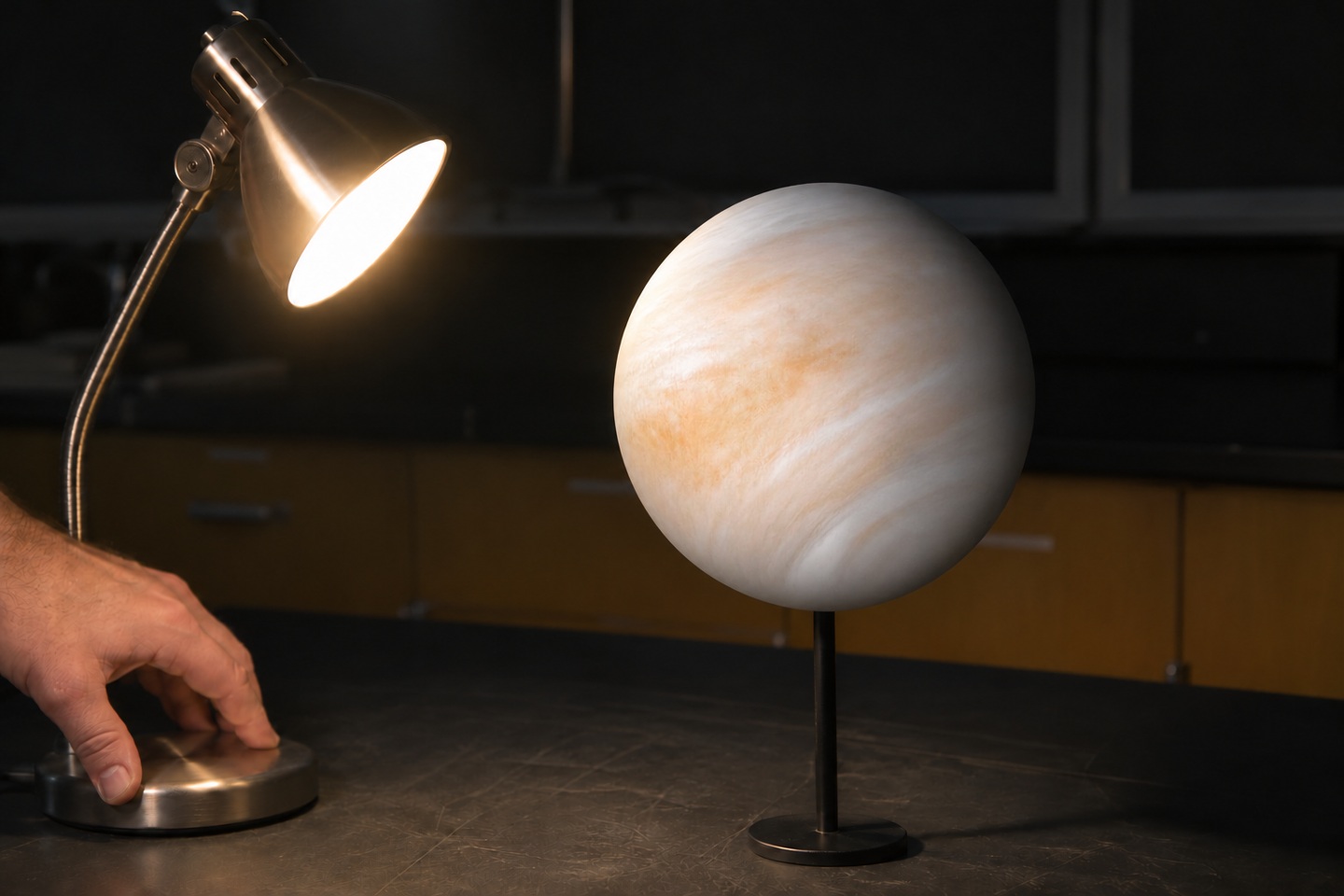
Our illustration uses a Venus globe with cloud colours inspired by NASA/JPL-Caltech’s processed Mariner 10 imagery. You can try the same lighting demonstration with one matte ball and a lamp. Keep the lamp fixed and move your viewing position around the ball. The light source continues to illuminate one side, while the portion of that side you can see changes. Do not paint a black patch onto the ball: that would confuse the ball’s own colouring with the boundary created by illumination.
A household model cannot reproduce Venus’s clouds, scattering or orbital scale. Its value is narrower and more useful: it makes the distinction between an object’s surface and the way light falls on it easy to discuss. State the model’s purpose before asking it to explain more than it can.
What Galileo’s observation could rule out
The Museo Galileo’s account of the phases of Venus places Galileo’s telescopic observations in 1610. It explains why the observed range of phases conflicted with the arrangement of Venus in the traditional Ptolemaic model. The observation therefore had consequences beyond the appearance of one planet: a proposed arrangement had to account for a pattern it could not accommodate.
The museum also adds an important qualification. Tycho Brahe’s geocentric arrangement could accommodate the phases. Observing them did not, by itself, distinguish every possible solar-system model or establish all the evidence for Earth’s motion. It challenged one arrangement without answering every remaining question.
This is a useful example of scientific reasoning because the conclusion has a defined reach. “This model fails this observation” and “this observation proves every part of another model” are different statements. The stronger historical story is not weakened by preserving that difference. It becomes easier to understand what made the evidence consequential.
Keep an observing record that can be compared
If you plan to observe Venus, begin with a reliable current sky guide for your location rather than assuming it is visible tonight. This article gives no present position, rise time or best-viewing date. Venus appears near the Sun in the sky, so never sweep a telescope or binoculars around the Sun to search for it. For a beginner’s session, choose a verified opportunity with the Sun fully below the horizon.
Record the date, local time and time zone, observing place, instrument and magnification. Describe the visible shape separately from your impression of brightness. Was the outline steady? Was glare making it difficult to judge? A short description of the conditions is more useful than forcing an exact illuminated percentage from an uncertain view.
For photographs, also retain exposure and processing information. A brighter-looking file might reflect a longer exposure, altered contrast or a different display stretch. If you resize every planet image to the same diameter, say so. A comparison can be carefully designed for one purpose without being suitable for another.
Finally, separate what you saw from what a calculation supplied. “I saw a crescent” records an observation. A predicted illuminated fraction from a named ephemeris records a calculation. When they disagree, checking the timestamp, image orientation and observing conditions is more productive than treating the discrepancy as a personal omen.
Leave room for meaning without changing the measurement
Someone might choose the crescent as a metaphor for an unfinished project that nevertheless has a strong presence. That is an original reflective association, not an astronomical result or a traditional rule established here. It does not show that Venus will improve a relationship, increase income or determine another person’s feelings.
The planet offers a more grounded invitation: notice which variable your first impression has left out. A narrow illuminated fraction can coexist with a large apparent disk. A striking observation can challenge one model without settling every alternative. Keeping those distinctions visible gives both observation and interpretation a clearer place.
Sources and further reading
The linked NASA resources support the illumination, distance and planetary-background discussion; Museo Galileo supports the historical comparison. The circle exercise, model guidance and recording method are original editorial explanations. Both images are original AI-generated photographic-style illustrations of a modern observing setup and a classroom lighting demonstration, not actual dated observations of Venus or historical events. Continue with planetary viewpoint and retrograde motion, lunar phase and local visibility, or our Tarot Guides.