
Astrology, Astronomy & Culture
The Astrolabe: Where Sky Measurement Meets Meaning
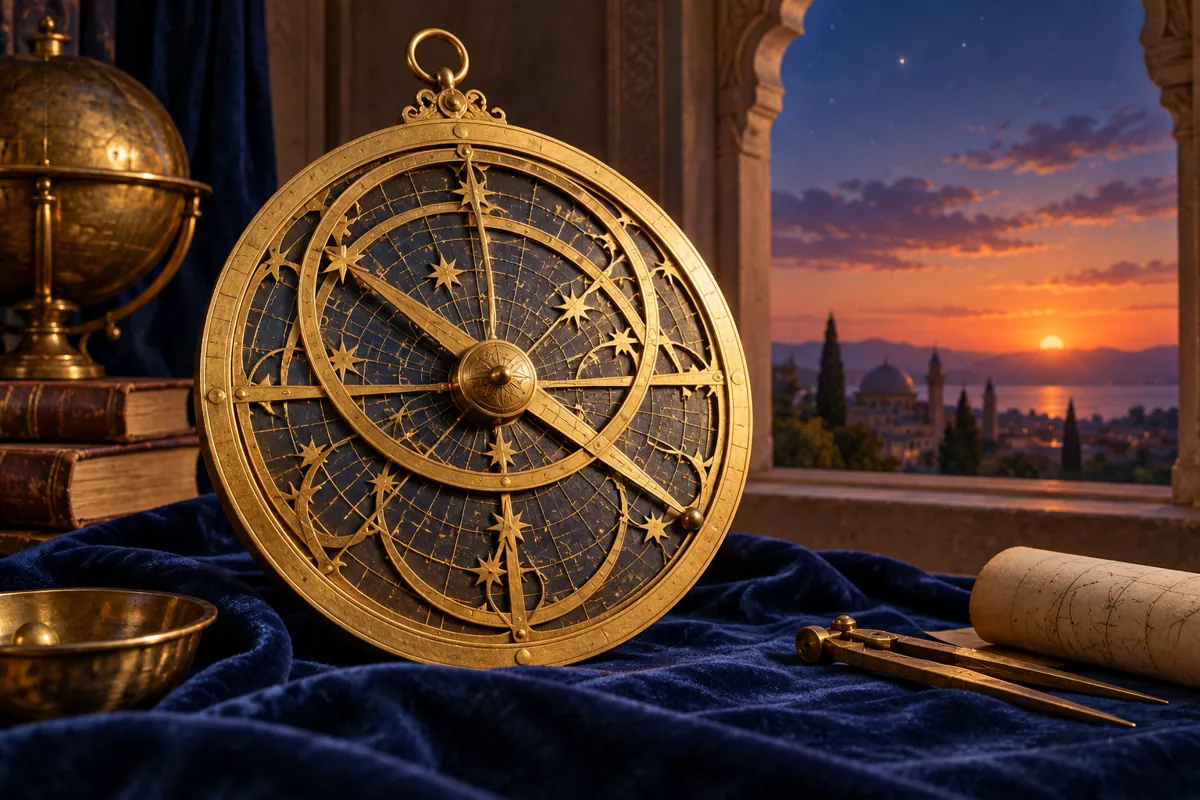
A brass disk can look like a promise that the sky has become readable. Turn its delicate framework and the stars seem to move beneath your fingers. But what, exactly, has been learned? The astrolabe offers a particularly revealing answer: an instrument can help establish a celestial relationship without deciding what that relationship means for a human life. Its history brings craftsmanship, calculation and belief into the same small object.
A thousand-year milestone, with a calendar attached
There is a timely reason to look again. In an announcement dated 22 February 2026, National Museums Scotland marked the thousandth anniversary of an astrolabe made in Córdoba by Muhammad ibn al-Ṣaffār. Its inscription dates it to 417 AH, corresponding to 1026–1027 CE. The anniversary belongs to this documented instrument, rather than to a supposed single moment when all astrolabes were invented.
That date range is part of the story. A year recorded in one calendar need not fit neatly inside a January-to-December year in another. Keeping both dates visible preserves information that would disappear in a tidy but misleading birthday. Historical precision sometimes means retaining a range instead of selecting a convenient day.
It also changes how we look. This is not merely an anonymous emblem of ancient wisdom. A named maker worked in a particular city, inscribed a date and produced a usable object. Asking about that evidence makes the instrument more interesting than treating its age as a reason to accept every claim associated with it.
A sky model you can hold
The History of Science Museum in Oxford describes the astrolabe as a sky map on a flat disk. A rotating framework called the rete carries the star map; moving it models the sky’s apparent daily motion. The museum places these instruments among tools for timekeeping, prayer calculations and measuring heights and angles, as well as historical attempts at prediction.
Consider the difference between a picture and a model. A picture might show a beautiful sky once. A model allows a relationship to be changed and examined. Rotation is therefore more than decoration: it makes the object something the user can work with. The appeal is tactile as well as visual, because a calculation becomes an arrangement of physical parts.
This is also why a zodiac ring on an instrument should not automatically be read as a personal horoscope. Before interpreting a symbol, ask what task the surrounding scale performs. A sign can have a role in locating the Sun along its apparent annual path without making a statement about someone’s character or future.
The plate underneath matters
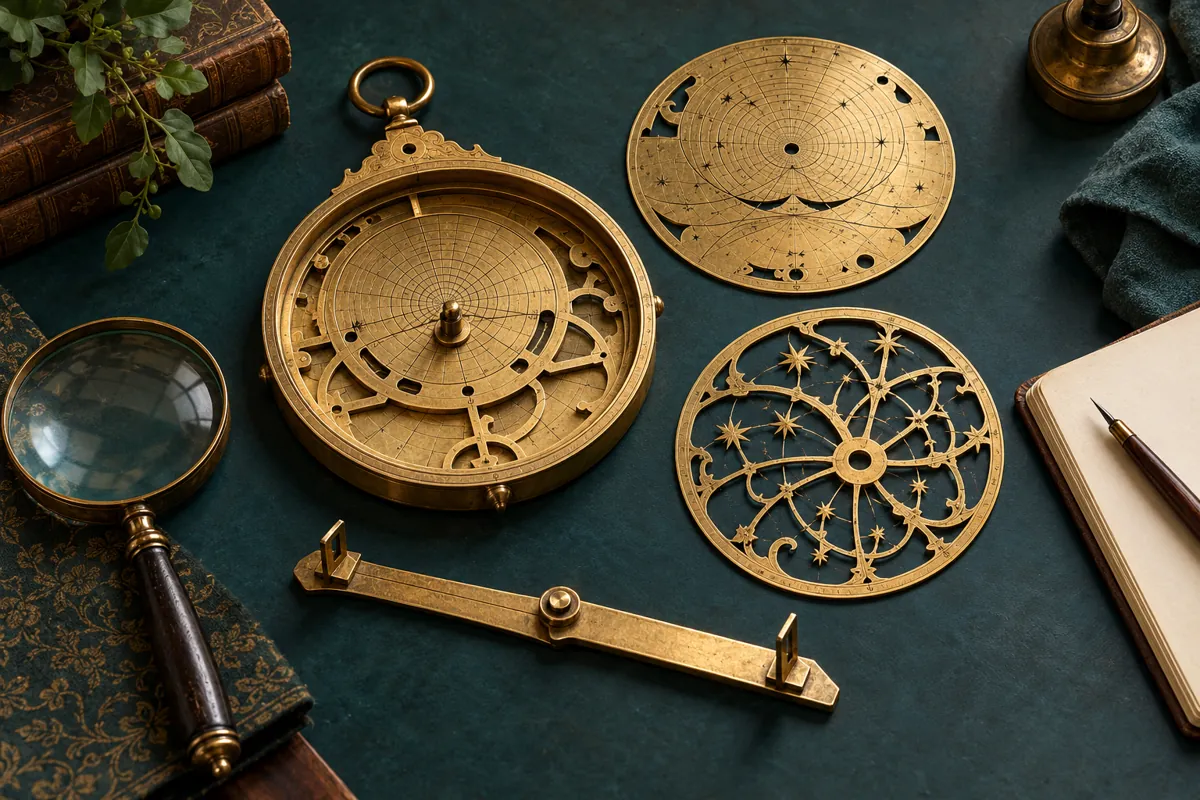
National Museums Scotland’s detailed object study explains that the body, or mater, can hold plates for different latitudes. The Córdoba instrument has seven plates engraved on both sides for fourteen latitudes. Its rete is a later component, probably from the thirteenth century. The back includes calendrical scales, a shadow square and a sighting device called an alidade.
Those details make two useful distinctions. First, an instrument depends on its setup: a plate is not a neutral background that can always be ignored. Second, a surviving object can contain parts from different periods. “Made in the eleventh century” does not mean that every visible component necessarily left the original maker’s bench together.
For a museum visitor, this suggests a better question than “How old is it?” Ask which part is being dated and what evidence supports that date. For someone comparing modern chart software, the parallel is methodological: record the settings before comparing outputs. Our story about different zodiac reference systems explores why matching the birthday alone is not enough to ensure matching chart labels.
Craftsmanship has a paper trail
A second example makes the maker’s knowledge unusually visible. The Metropolitan Museum of Art’s astrolabe dated 690 AH/1291 CE is attributed by inscription to the Rasulid prince ʿUmar ibn Yusuf. The museum connects it with his treatise on astrolabe construction: an autograph version preserved in Cairo includes teachers’ certifications of his competence and a description of this instrument.
That combination of object, inscription and written account gives us several ways to investigate a claim. It does not require imagining what the maker secretly believed, or treating every decorative feature as a coded message. The technical work itself deserves attention: a person learned a demanding craft and left evidence by which others could recognize it.
There is a useful lesson here for reading any impressive tool. Authority becomes easier to assess when its basis can be inspected. A polished surface may attract us, but a description of inputs, construction and intended use tells us more about what the tool can actually do. Beauty and accountability can coexist.
Shared instruments, different worlds of meaning
Oxford also cautions that instruments from the Islamic world were made across several regions and that their makers were not all Muslim. A collection category describes a historical setting; it does not supply a complete identity for every person who worked within it. The same broad family of tools can travel through different communities and purposes.
Compare the Met’s astrolabe dated 1462, catalogued as German or Italian and associated with Regiomontanus. Its inscription names Cardinal Bessarion as patron; its engraved reverse includes an angel. The museum discusses it as an object joining astronomical calculation with art and faith.
These examples invite comparison without flattening difference. Who commissioned an instrument? What does its inscription identify? Which parts perform calculations, and which express devotion or patronage? Two objects can share a mechanical idea while telling different social stories. Neither needs to become a representative of an entire civilization by itself.
Follow a result through three separate questions
Try this exercise when you next encounter an astrolabe in a gallery or catalogue. Begin with the observable object: name a movable part, an inscription or a scale that the catalogue actually identifies. Then ask what operation that feature supports. Finally ask which additional assumptions would be needed to turn the result into a statement about a person.
For example, determining a celestial position and interpreting that position as favourable for a relationship are different operations. The first can be checked against observations and calculations. The second depends on an interpretive tradition and does not acquire proof merely because its starting coordinates were carefully measured. Technical precision cannot, by itself, validate a personal prediction.
You need not dismiss an object’s cultural meaning to keep that distinction. A tool can illuminate how people organized time, expressed faith and sought guidance. Its historical use is evidence about human practices; it is not automatically evidence that every expected outcome occurred. Respectful curiosity allows both appreciation and scrutiny.
Let the instrument make the question sharper
The astrolabe’s lasting fascination lies partly in how much it makes visible: moving parts, chosen settings, skilled workmanship and traces of ownership. Looking closely replaces a vague aura of certainty with specific questions that can be investigated.
When a sky-based interpretation feels persuasive, borrow that habit. Ask what was measured, which model was used and where the interpretation entered. The brass instrument cannot decide your life. It can, however, teach a wonderfully concrete way to examine the journey from an observation to a claim.
Sources and further reading
The linked museum announcement supplies the 2026 anniversary; the National Museums Scotland object study explains the surviving components. Oxford supplies the wider instrument context, and the two Met records document individual objects. The comparisons and reader exercise are original Precise Arcana editorial analysis. Both illustrations are newly generated conceptual artwork, not photographs, technical diagrams or reconstructions of the cited artefacts. Explore our Tarot Guides for related approaches to reflective reading.