
Astrology & Astronomy
Why Zodiac Signs Differ: Tropical, Sidereal and Constellation Maps
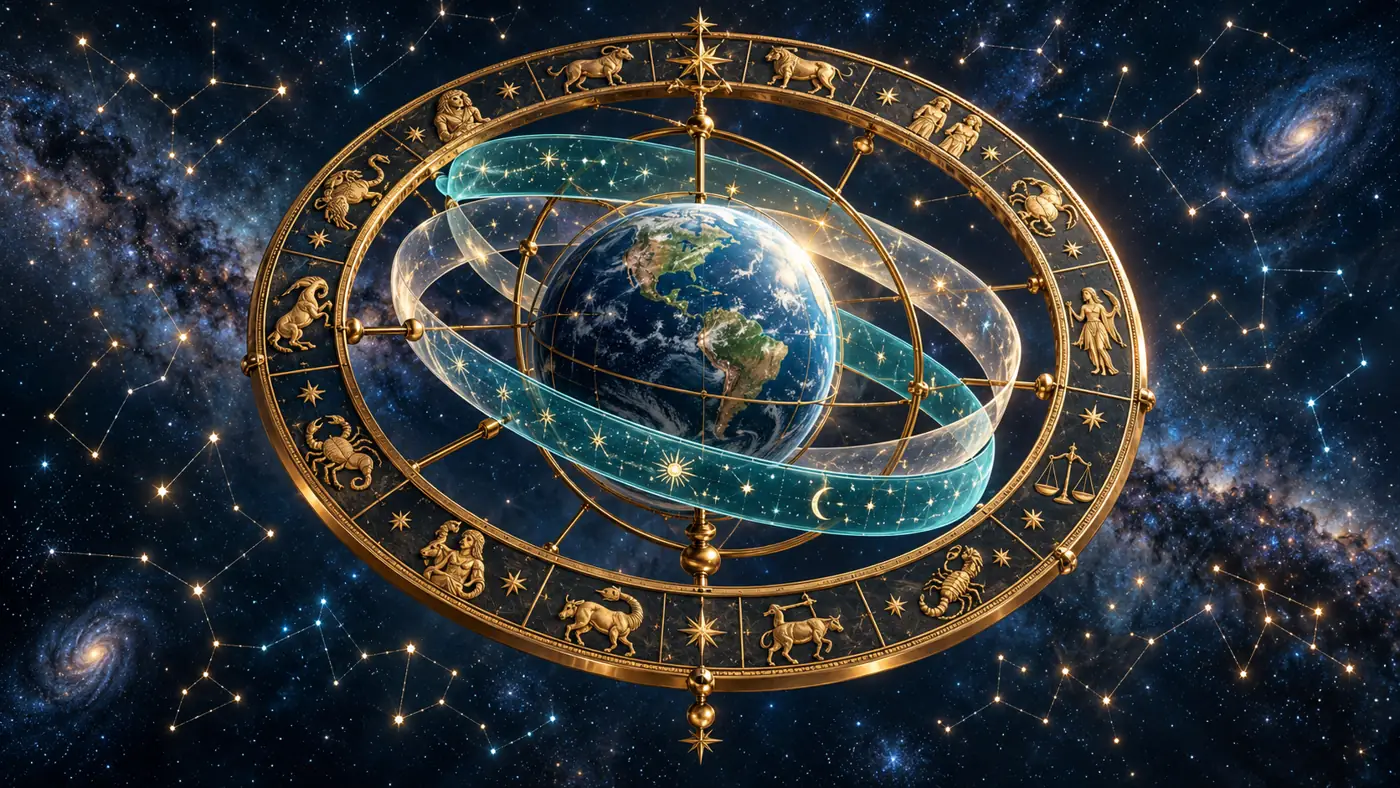
Two charts use the same birthday, yet one gives a different zodiac sign. Before deciding that a calculation has failed, look at what each chart is measuring. A sign name can belong to more than one reference system, and a constellation label answers another question again. Understanding those distinctions makes it easier to compare results, ask a reader useful questions and keep a symbolic interpretation in proportion.
Start with the label beside the result
Imagine receiving two addresses for the same building: one describes its distance from a station, the other its position on a street. Different numbers need not mean different buildings. A reference point matters. With zodiac charts, the first useful question is therefore: which zodiac did the calculation use?
In the tropical zodiac, the March equinox defines 0° Aries. A sidereal zodiac instead sets its origin relative to a stellar reference. The Swiss Ephemeris general documentation, section 2.8, explains these conventions and the offset between them, called an ayanamsha. It also documents multiple sidereal definitions, including Lahiri and Fagan/Bradley. “Sidereal” alone does not identify every calculation setting.
This is a reason to keep the method attached to the answer. “My chart says Aries” is incomplete information when comparing systems. A more useful record includes the object being measured, its degree and the named zodiac. That small habit turns an apparent contradiction into something you can investigate.
What precession changes
Earth’s rotational axis slowly changes direction. NASA describes this motion, precession, as a cycle taking approximately 26,000 years. Its reference-systems chapter explains why astronomy needs stated reference frames and epochs when describing positions. The equinox reference consequently changes against the stellar background over long periods.
That slow motion helps explain why a system tied to an equinox and one referenced to stars do not remain aligned. It does not mean that an individual has suddenly changed character, or that an observatory has issued a revised personal identity. A measurement convention and a personality claim are different kinds of statement.
A useful comparison is a clock whose face can be turned while its hand keeps pointing in the same direction. Moving the numbered scale changes the reading without requiring the hand to jump. This analogy is deliberately limited: it explains the importance of an origin, rather than reproducing the full geometry of Earth’s motion.
A small calculation makes the difference visible
Conventional tropical and sidereal signs divide a circle into twelve equal sectors of 30°. For an elementary conversion, subtract the chosen ayanamsha from tropical longitude. The Swiss Ephemeris documentation gives this relationship. Consider an invented longitude of 40° and an illustrative offset of exactly 24°: the result is 16°. In sign notation, that changes 10° Taurus into 16° Aries.
Those numbers are a teaching example, not a calculated birth chart or an ephemeris for today. The example shows why changing the origin can change the sign label. It cannot tell you which tradition to practise, whether an interpretation fits your life, or what will happen next. Actual calculations require the appropriate offset for the date and selected method.
Notice what makes the example inspectable: both the input and the rule are visible. If someone simply announces that one result is “more accurate,” ask what that accuracy refers to. Agreement with a named calculation convention can be checked. Claims about destiny require a different kind of evidence.
A constellation is another kind of map
The International Astronomical Union’s constellation reference defines a constellation as a bounded area of sky. The IAU recognises 88 such regions across the whole celestial sphere. Their outlines are irregular; they are not twelve interchangeable 30° sectors. The familiar lines joining bright stars are illustrations, rather than the official boundaries.
This means that selecting a sidereal sign does not automatically select the same-named astronomical constellation. To identify a constellation, a sky map must use its boundaries. To identify a conventional zodiac sign, a chart uses its chosen divisions and origin. Similar vocabulary can conceal different tasks.
Ask which map serves your purpose. If you want to identify the region containing a photographed object, astronomical boundaries are relevant. If you want to understand a traditional chart, its declared zodiac is relevant. Neither task benefits from silently borrowing the other’s labels halfway through an explanation.
Compare charts by changing one thing at a time
A practical comparison starts with a written record, not with whichever description feels most flattering. Save the input date, time, place and calculation settings alongside each result. If the birth time is uncertain, preserve that uncertainty rather than replacing it with a convenient exact minute.
First confirm that both results refer to the same object: a Sun placement should be compared with a Sun placement. Then check the zodiac, the sidereal method where applicable, and the numerical longitude. Only after that should you compare interpretations. Otherwise, you may spend time explaining a difference that began with mismatched inputs.
Keep house-system choices separate from zodiac choices. The Swiss Ephemeris programmer documentation treats sidereal modes, time conversion and house calculations as distinct operations. That separation supports a useful checking habit: alter one setting, record what changed, then move to the next. It is easier to locate a discrepancy when five controls have not changed together.
If a service hides its assumptions, ask for them before accepting a technical explanation of the result. You do not need to become an astronomer to request the method. Clear labels help a reader understand what has actually been calculated.
Keep calculation and interpretation separate
It is possible to calculate a position consistently within a declared system without demonstrating that the position predicts a person’s behaviour. NASA Space Place’s explanation of constellations distinguishes astronomy’s evidence-based study of space from astrology’s cultural and predictive beliefs. A precise chart does not, by precision alone, validate its interpretation.
For personal reflection, that distinction can be useful rather than discouraging. You might use a symbolic description to consider how you handle uncertainty. The worthwhile next step is an example from your life, including a counterexample, rather than an assertion that the description must be true because a chart contains many decimal places.
Suppose a reading invites you to consider independence. Write down a recent occasion when acting alone helped, and another when asking for support would have helped. This is an original reflection exercise, not a prediction attached to either zodiac. It remains useful even if you later choose a different chart tradition.
Conclusion: make the question more precise
When two sign labels disagree, begin with the reference system, inputs and calculation settings. When an interpretation makes a claim about your life, examine that claim separately. Understanding the map gives you a clearer conversation; it does not oblige you to accept every story told about the territory.
The same care can improve a tarot question. Instead of asking which label determines who you are, ask what you can understand or do more thoughtfully. Our guide to asking tarot questions offers a starting point, and the Star card page provides a symbolic prompt about hope. Neither substitutes for an astronomical chart or evidence about an actual decision.
Sources and further reading
Calculation conventions: Swiss Ephemeris general documentation and programmer documentation. Astronomy: NASA, Reference Systems; IAU, The Constellations; NASA Space Place, What Are Constellations? The analogies, comparison procedure and reflection exercise are Precise Arcana’s own explanations.