Divination Culture & Practice
Moon Blocks: Why the Question Comes Before the Cast
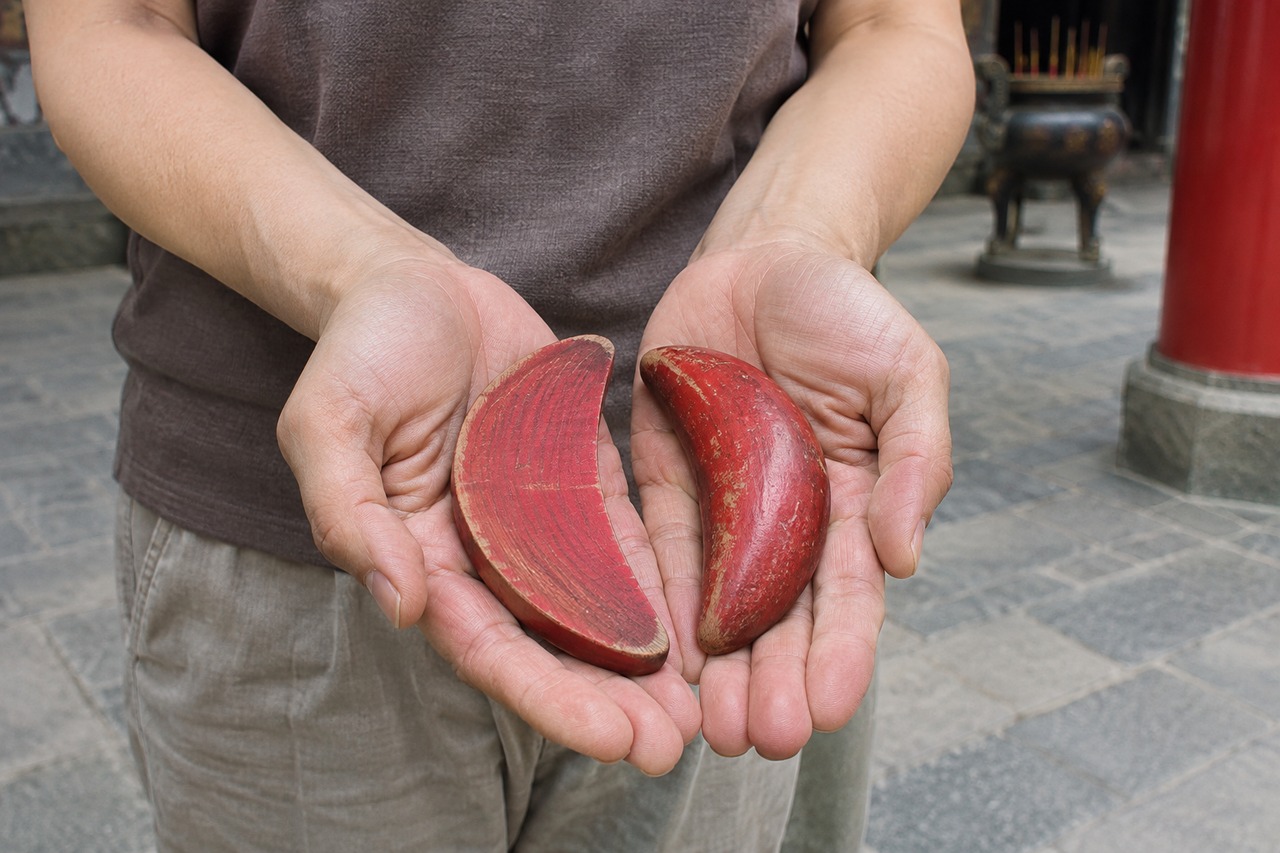
Two curved blocks can look like a very small instrument for a very large question. Held in the hands and released onto the floor, moon blocks offer a compact set of visible results. Yet the practice does not begin with the fall. It begins with someone addressing a question, deciding what is being asked and recognizing what would count as a response. Looking at jiaobei through museum objects and a temple’s own guidance reveals a conversation with a setting, rather than a universal answer machine.
A shape with two different faces
The Powerhouse collection’s Chinese divination blocks are a pair of crescent-shaped wooden objects dated to 1900–1925. The catalogue describes a flat face and a rounded face on each block. Its particular pair is dark wood, connected by a short string. The familiar red pair seen in many representations is therefore not the only material appearance worth recognizing.
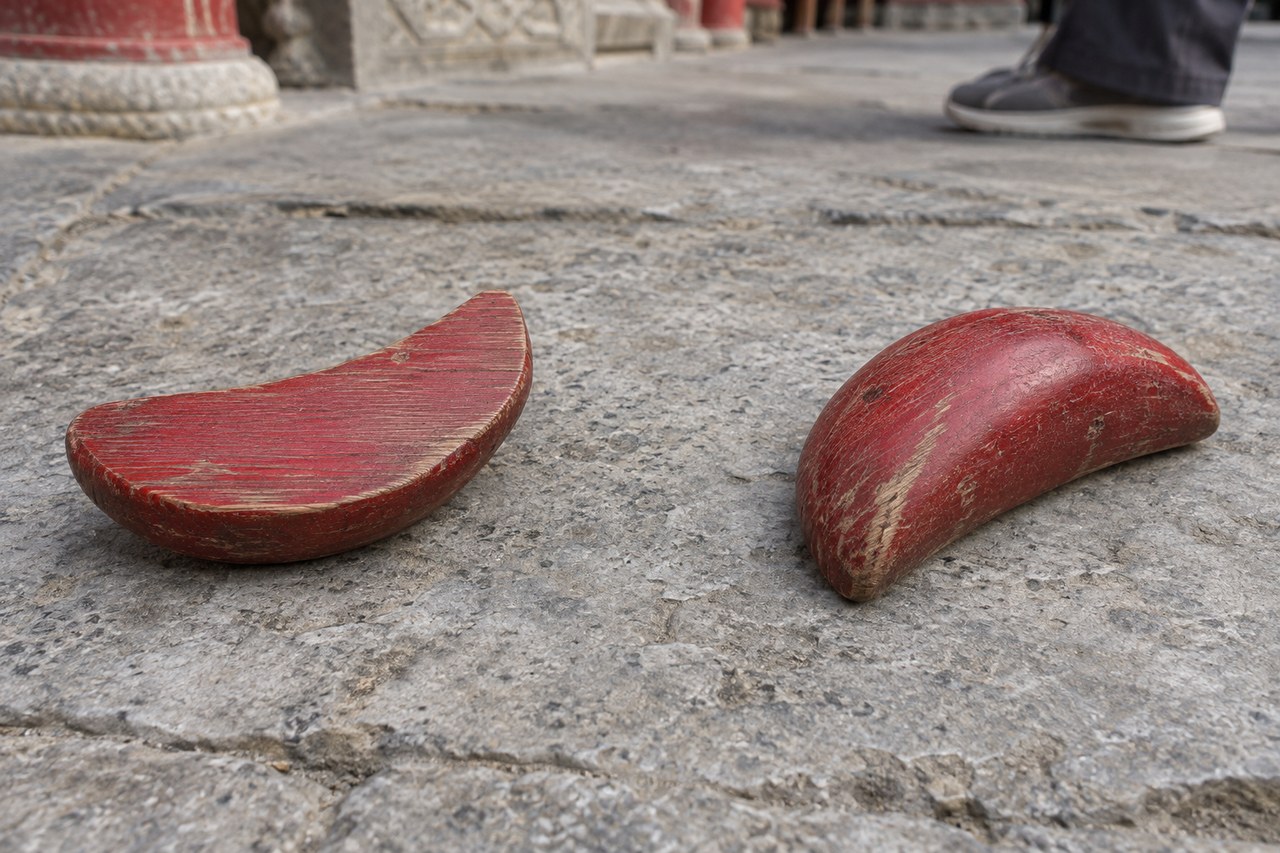
The asymmetry is essential to understanding the object. Turning a block over changes which broad surface is uppermost. A crescent outline viewed from above does not show that difference on its own; the object has thickness and a shaped underside. Looking at a side view can explain something a decorative silhouette conceals.
Our illustrations use invented red-painted examples, not reproductions of the Powerhouse pair. One scene emphasizes holding the objects before casting; the other emphasizes the contrast between the upward-facing surfaces. Their purpose is to make an aspect of the form legible, without presenting generated imagery as collection photography.
The museum object has its own biography
The Horniman Museum’s record for one divination block, numbered 1973.15.1, identifies bamboo as its material and describes it as one of a pair. The recorded dimensions are 135 by 25 by 75 millimetres. Its commentary connects the object with discerning a deity’s will or communicating with ancestors.
Those details do different jobs. The material and measurements describe a particular object. The commentary describes an attributed religious use. Neither supplies a complete transcript of every occasion on which this individual block was handled. A catalogue can preserve useful knowledge without preserving every action in an object’s life.
The Horniman also warns that collection information can be incomplete, contain errors or retain historical language. That invitation to read critically matters. A short label should not silently expand into a rule for all Chinese communities, all temples or all periods.
For a visitor, the productive question is therefore quite specific: what does this record establish about this object, and what broader account is being attached to it? Keeping the two visible allows the physical example to remain particular while still opening a view onto a wider practice.
Listen to the institution describing its own practice
Hsing Tian Kong’s English guidance on divination blocks begins with seeking guidance from the Saviors and calming troubled or indecisive thoughts. Its instructions ask a participant to state personal details and the matter under consideration, express the main points clearly, and ask one question at a time in a form that can receive a yes-or-no answer.
The page describes holding the blocks between the palms, pausing and casting gently. It labels three results: yes, no and smiling blocks. For the smiling result, it suggests that the question may be unclear or that the questioner already knows the answer. These are the temple’s descriptions within its religious framework, not independently verified communication from a supernatural source.
Notice how much work happens before the release. The question is selected, narrowed and addressed to someone. Removing those steps and calling the objects a random yes-or-no generator leaves out how the temple itself presents their use.
That does not require an outside reader to adopt the belief. It requires accurately describing whose account is being considered. A museum catalogue and a religious institution’s instructions are different kinds of source; each can contribute without being asked to stand in for the other.
Three categories do not automatically mean equal chances
There is a small mathematical distinction worth keeping separate from ritual interpretation. Imagine labelling the blocks A and B solely for an explanation. If each finishes with either its flat or rounded face uppermost, the labelled combinations are flat/flat, flat/rounded, rounded/flat and rounded/rounded.
When the two mixed cases are grouped together, four labelled combinations become three categories. That grouping does not, by itself, make each category equally likely. Counting the names assigned to results is not a measurement of the objects’ behaviour.
For an explicitly hypothetical model, suppose each face has an equal chance and the blocks behave independently. The mixed category would then contain two of the four equally likely combinations, while each matching category contains one. This is arithmetic under stated assumptions, not an experimentally established probability for real moon blocks.
Real objects would require observation before such assumptions could be justified. Nor would a measured frequency, on its own, confirm or disprove a participant’s entire religious understanding. The modest point is that the number of interpretive labels cannot supply missing information about physical chances.
A block can confirm a step rather than tell the whole story
The temple’s separate guidance on divination lots places blocks within a longer sequence. It describes asking permission to draw a lot, noting the lot’s number and using the blocks to confirm whether the associated poem is the intended one. The participant then collects the corresponding poem and can ask the person on duty to explain it.
Here the blocks and the poem are not interchangeable. The number connects a drawn lot with a text; the blocks participate in permission and confirmation; explanation introduces another person. Treating one visible fall as the whole practice would erase those relationships.
The Powerhouse account, meanwhile, describes a convention of three consecutive positive falls. That should remain attributed to that account, rather than be added silently to every temple’s instructions. When procedures are presented differently, identify the source and setting instead of manufacturing one supposedly universal rule.
What a reader can learn before borrowing a ritual
There is an accessible exercise here that needs no blocks and does not claim to reproduce a religious ceremony. Take an ordinary, low-stakes decision and write the question exactly as it first occurs to you. Then underline every separate issue hidden inside it.
For an invented example, “Should I join the class, buy the materials and change my weekly schedule?” contains several decisions. Dividing it into separate questions reveals that enthusiasm for one part may be concealing uncertainty about another. Clearer wording has produced useful information before any answer is sought.
Next identify what a yes or no would leave unresolved. A yes to joining a class does not explain its cost, transport or suitability. Ask which of those details can be investigated directly. This is original editorial guidance about framing a decision, not a claim that temple consultation is reducible to a planning worksheet.
If visiting a living religious setting, follow its own guidance and seek help from its staff where appropriate. An online article cannot appoint itself the authority over someone else’s worship. Curiosity becomes more informative when it leaves room for participants to explain what their actions mean to them.
Return to the pause before the fall
Moon blocks bring a tactile form into a human exchange. Their surfaces make outcomes visible, but their setting gives those outcomes a role. Collection records preserve particular examples; a temple explains a practice; a reader brings further questions.
The pause before casting may be the most revealing place to begin. What is being asked? Who is being addressed? What would a response settle, and what would still need attention? Those questions keep the pair from becoming a generic symbol of certainty, while allowing its cultural and religious meaning to remain substantial.
Sources and further reading
The four linked museum and temple resources support the object descriptions and attributed practices. The mathematical model and question-framing exercise are original editorial analysis, not ritual instructions or evidence of predictive effects. Images are original AI-generated photographic-style illustrative reconstructions, not actual artifacts or documented ceremonies. For other material settings of divination, read about geomancy’s changing surfaces and Shang oracle bones, or explore our Tarot Guides.