
Divination History & Culture
Geomancy: From Marks in Sand to Dials in Brass
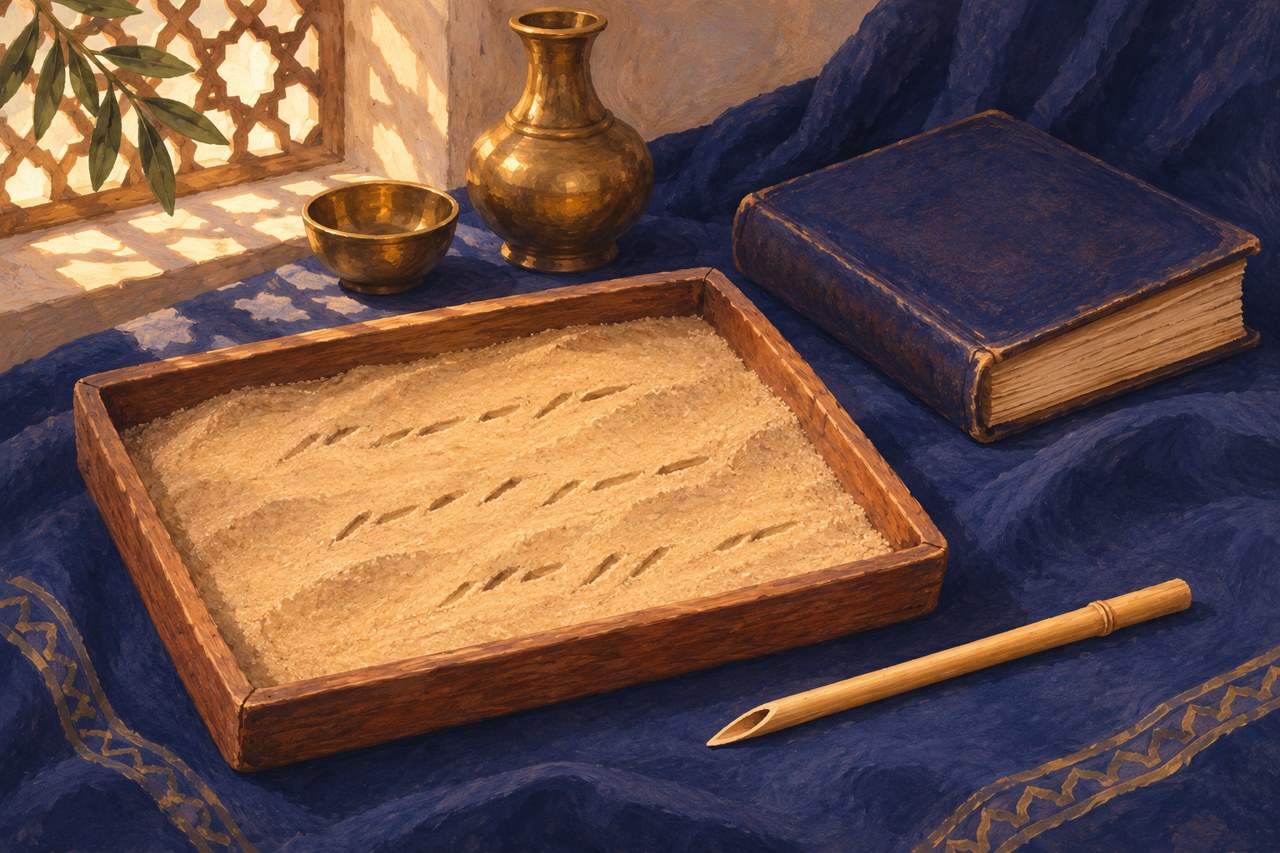
A mark in sand can vanish with the sweep of a hand. A mark in a manuscript can survive beside a text its reader was studying. A pattern displayed through a brass window can be changed by turning a dial. Geomancy connects these very different surfaces through a practice of forming figures and interpreting them. Its surviving evidence offers a revealing history of how a question becomes a pattern, how a pattern becomes a record, and how an elaborate object can make that process tangible.
A specific meaning of geomancy
The Arabic term ‘ilm al-raml is commonly translated as “the science of sand.” Here, geomancy means this tradition of dot figures and tableaux. The National Library of Medicine’s catalogue introduction distinguishes it from astrology: its figures could be generated without astronomical observation or calculation. A tableau organized those figures into sixteen positions. The catalogue also points to examples preserved in manuscript margins.
That definition keeps the subject from spreading too far. The NLM glossary cautions that the English word has also been applied to Chinese practices concerned with landforms, which it distinguishes from the Islamic tradition. Sharing a translated label does not establish that two practices share the same procedure or history.
The word “science” in the historical name also needs care. It identifies a body of organized knowledge as its practitioners understood it. It does not mean that a modern experiment has established the accuracy of its forecasts. We can study the method’s structure, language and material traces without treating its claims about unseen events as demonstrated facts.
How many figures can four rows make?
The NLM glossary describes generating rows of dots, determining whether each row contains an odd or even number, and representing that result with one or two dots. A figure has four such rows. The first four figures contribute to the formation of the rest of the tableau through prescribed procedures; interpretation then depends on more than the mere presence of a shape.
The small number of possible figures follows from the structure. With two choices for each of four rows, there are 2 × 2 × 2 × 2, or sixteen possible arrangements. This arithmetic explains the size of the vocabulary. It does not establish what any arrangement means or whether a prediction made from it will be correct.
There is a useful distinction between a figure and a position. Think of sixteen available stamp designs and sixteen places on a sheet: the number of designs does not tell you which design occupies which place. That is an analogy, not a historical tool description. It helps explain why finding a familiar dot pattern in a photograph is only the beginning of understanding a tableau.
Nor should sixteen positions be taken to mean that a chart must display every possible figure once. A vocabulary can be reused. To follow a particular reading, we would need its starting marks, the procedure for deriving later entries and the interpretive conventions being applied.
The margin as a place of use
Manuscript evidence adds something a tidy modern chart cannot. The NLM catalogue identifies generating lines and tableaux in the margins of several volumes, including an example in MS P 28. A reader encountering those traces is looking at activity attached to a physical book, rather than simply a description of an abstract system.
A margin is an especially interesting surface because it has a relationship to another text. Questions immediately arise: was the addition made by the original copyist or a later reader? Does the surrounding writing explain it? Is the page complete? An isolated crop can preserve the dots while removing the information needed to answer those questions.
These are questions to investigate, not conclusions to impose on every manuscript. A diagram can show that a pattern was recorded without revealing the exact occasion, question or outcome. It is tempting to supply a vivid scene of someone seeking advice. Unless the page or catalogue supports it, that scene remains our imagination rather than the manuscript’s testimony.
When the surface becomes a mechanism
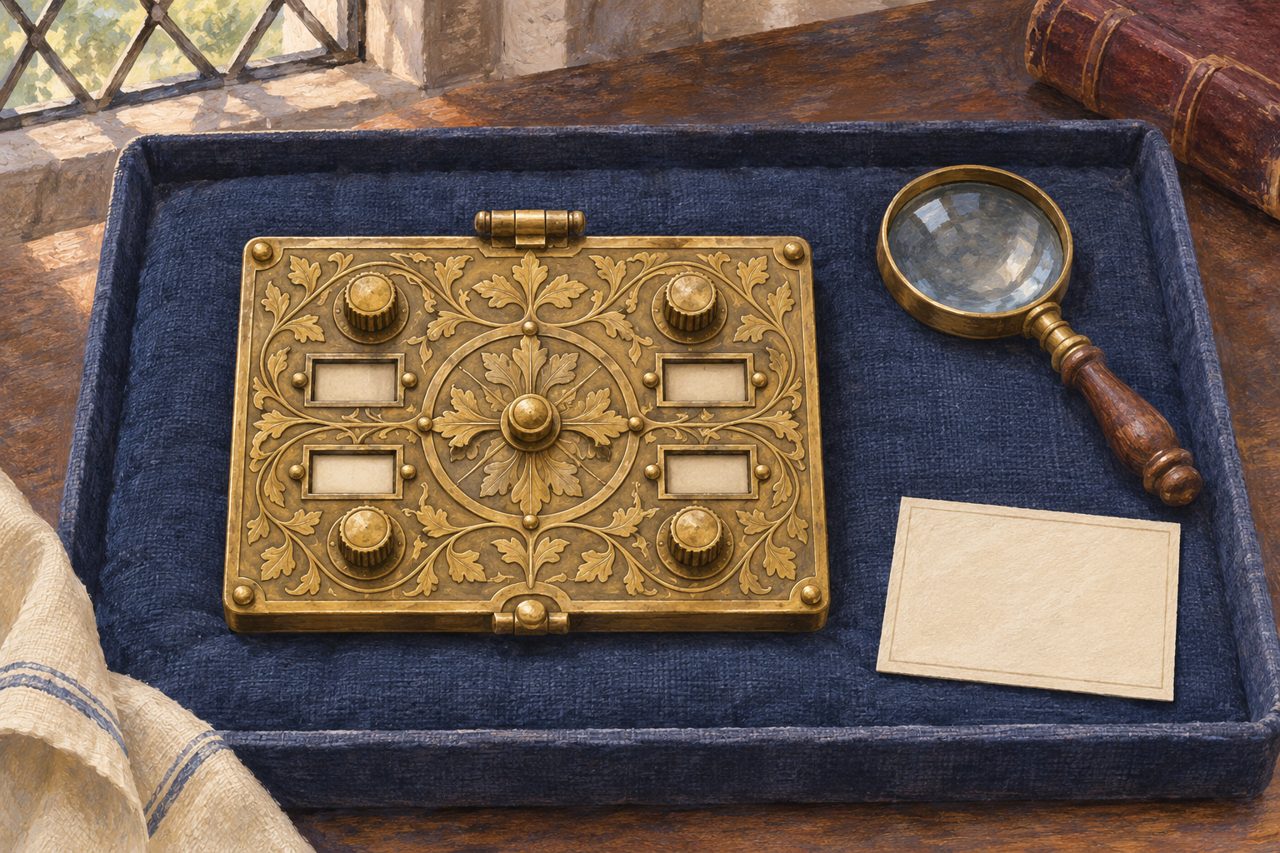
The British Museum’s geomantic instrument, number 1888,0526.1, turns the subject into metalwork. Dated 1241–1242, or AH 639, it is a brass object inlaid with gold and silver. Its smaller components include twenty circular dials and four sliding arcs. Windows expose changing patterns, while inscriptions identify positions and explain aspects of the device.
The signed inscription names Muhammad ibn Khutlukh al-Mawsili. The Museum lists Syria, probably Damascus, as its production place. This is not a telescope gathering light or an instrument measuring a planet’s altitude. Its moving parts support a divinatory procedure. Sophisticated craftsmanship and a claim to knowledge of the future are two different things to assess.
Our editorial observation is that moving a procedure into a durable mechanism changes the experience of using it. A dial can retain a setting; a window can isolate one pattern; a labelled surface can organize attention. Those affordances are interesting even when we leave predictive claims unproven. The instrument shows ingenuity in making a symbolic practice operable.
The image beside this section is deliberately an invented conceptual object with blank windows. It illustrates the idea of a mechanical surface, not the Museum’s dial arrangement, inscriptions or operating instructions. The linked record is the place to inspect the documented instrument.
A maker’s name is not a manufacturing address
The Museum With No Frontiers catalogue entry preserves a valuable qualification about origin. It lists Egypt or Syria and explains that the maker’s designation al-Mawsili connects him with Mosul. That connection does not establish that this object was manufactured there. The entry notes another signed work associated with Damascus and discusses that city as a possibility for the geomantic device.
The date is differently grounded: the entry identifies the instrument’s inscribed year as the basis for dating it. This gives us an example of two kinds of evidence side by side. An inscription can support a date, while a name and comparison with another work contribute to a more tentative account of place.
Keeping those distinctions visible makes the object more specific, not less impressive. A label that says “probably” is giving the reader information. Removing that word to create a neater story would turn a reasoned proposal into a false certainty.
Read the pattern and its surroundings
A useful encounter with geomancy begins by naming the surface: sand tray, manuscript page or mechanical tablet. Next ask what the source actually documents. Does it show starting marks, a finished figure, a position in a tableau or a device capable of displaying several settings? These are related objects of study, but they are not interchangeable records of a complete reading.
Finally, separate the procedure from the forecast. A rule can reliably turn one arrangement into another while the interpretation attached to the result remains a matter of tradition. Demonstrating the transformation does not demonstrate a claim about a distant relative, a business venture or someone else’s thoughts.
Geomancy’s material history is compelling because a modest mark could become part of a carefully organized symbolic world. Sand offered an erasable surface, manuscripts preserved selected traces, and brass gave the process moving parts. Looking closely lets us appreciate that ingenuity while leaving the future open.
Sources and further reading
The four linked institutional resources support the historical and procedural descriptions. The arithmetic explanation, stamp analogy and comparisons of reading surfaces are original editorial analysis. Both illustrations are newly generated conceptual scenes. For related histories, explore our stories on oracle bones and the astrolabe, or visit the Tarot Guides for reflective approaches to symbolic reading.