Divination History & Culture
John Dee’s Mirror: Stone, Stories and the Limits of Evidence
A dark mirror invites a story before it offers much to look at. Add the name John Dee, and the surface seems ready to fill with angels, secret alphabets and Elizabethan intrigue. Yet the object associated with him also asks less theatrical questions. Where did its stone originate? Who attached its famous name? What survives from the people who handled it? Following those questions reveals several histories occupying the same small object, without requiring us to accept a supernatural explanation.
Begin with stone, not a vision
The British Museum’s presentation on Google Arts & Culture identifies the mirror as polished obsidian, or volcanic glass, made in Mexico and catalogued as Aztec. Its registration number is 1966,1001.1. The mirror has a projecting handle, and the accompanying case is made from wood and leather.
The Museum places mirrors within Mexica religious life, connecting them with Tezcatlipoca, whose name it translates as “Smoking Mirror,” and with priestly divination. This context matters before we reach the English owner with whom the object became associated. A material object can enter a new collection without having begun its life there.
Our editorial starting point is simple: a famous name should open an investigation rather than close it. Describing this only as an English magician’s tool makes its earlier cultural setting easy to overlook. Describing it only by its stone leaves out the changing human relationships that made it famous. Neither label can carry the entire history alone.
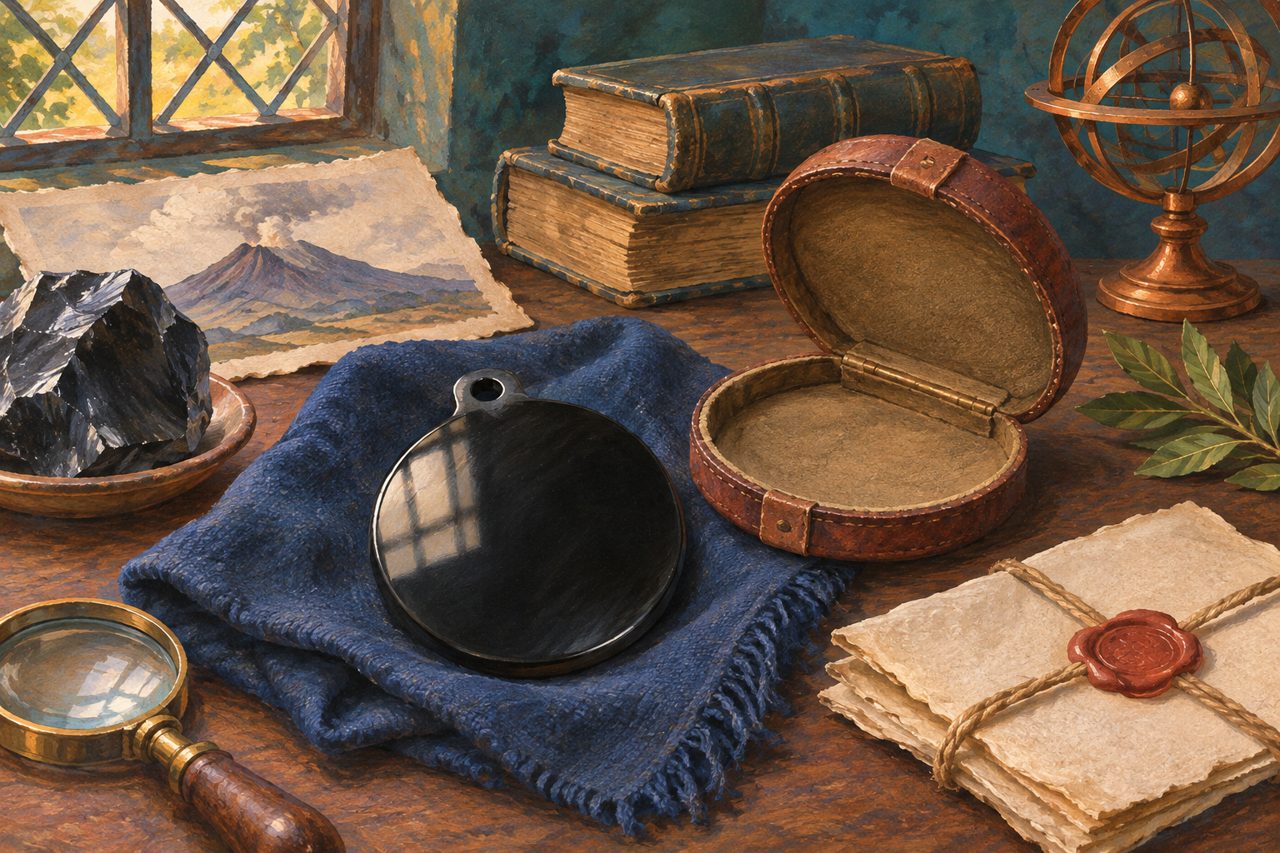
The header illustration is an invented still life. It offers a visual pause around a reflective surface, not a substitute for the collection photographs or a claim about the mirror’s original surroundings.
A geological answer has a particular scope
In a 2021 study in Antiquity, Stuart Campbell and colleagues examined this mirror and three related British Museum objects using portable X-ray fluorescence. They compared the results with geological samples. The mirror associated with Dee matched obsidian from Pachuca, Mexico; another circular mirror matched that source, while two further objects matched Ucareo.
The authors also discuss uncertainties in the mirror’s association with Dee and the route by which it reached him. They argue that the association is strengthened, but exactly when and how he acquired it remains uncertain. Their study concerns an object’s material and historical contexts; it does not establish that a mirror could communicate with spirits.
There is a valuable boundary here. Identifying a geological source does not identify every person who transported the stone. A result about material origin cannot automatically supply a shipping itinerary, an owner’s intention or a maker’s name. Those questions require their own evidence.
Imagine an invented family heirloom made from imported timber. Identifying the wood’s origin would be useful, but it would not tell us which relative bought the finished box. The analogy is modest: different questions about one object can have different kinds of answers, and different levels of confidence.
The case carries another kind of testimony
Turn from the stone to its surrounding documentation. Yale’s Lewis Walpole Library catalogue records the mirror within Horace Walpole’s Strawberry Hill collection. It identifies an eighteenth-century wooden case covered in tooled leather and reproduces descriptions from 1774 and 1784. The earlier description calls the object a “speculum of kennel-coal” and treats Dee’s supposed activities as deception.
The catalogue also records the gift to Walpole in 1771 and later sales, ending with the British Museum’s purchase in 1966. These entries give the object a documented collecting history, including the words through which collectors presented it.
The old material label and the judgement about deception should be read as historical testimony, not silently adopted as our own description. They show a later observer classifying both an object and someone else’s beliefs. An eighteenth-century account of an Elizabethan figure is not the same thing as a note written during an Elizabethan session.
This is where the case becomes more than packaging. It helps preserve a reputation as well as a fragile surface. The object and the account attached to it have travelled together, but they need not answer the same questions. We can study both without asking the later description to function as an eyewitness report.
Look beyond the most dramatic object
Dee’s surviving books offer a useful change of scale. A Royal College of Physicians article published on 22 February 2019 explains how the Archaeology of Reading project made books he used accessible through page images and transcribed annotations. The RCP distinguishes books that may have belonged to Dee from approximately one hundred titles with firm evidence, including signatures or annotations.
The same account describes his work with scryers: men who reported visions through crystals or polished surfaces, whose statements he recorded. This documents a practice and its reported experiences. It does not independently verify the beings the participants believed they were encountering.
A marginal note offers a different encounter from a dark mirror. It may let us follow an act of reading: a passage marked, a comment added, an image drawn. The contrast is useful because a person’s intellectual life need not be reduced to the object that produces the strongest modern atmosphere.
For a visitor interested in divination history, this suggests a rewarding habit. After looking at the celebrated instrument, look for the surrounding paperwork. A catalogue, annotation or dated description may complicate the first impression. That complication is often where the more interesting history begins.
Three questions to take into a collection
Here is an original viewing exercise, rather than a reconstruction of scrying. Choose an object in an online collection and write three short entries: what its material record establishes, what an owner or observer said about it, and what you personally imagine when you see it. Give each entry its own source or label it as your response.
Suppose the photograph makes a surface seem mysterious. That is a valid description of your encounter, but it is not evidence that every historical viewer experienced the same feeling. Suppose a collector calls an object magical. That records a classification; it still leaves questions about use, context and belief.
Then identify one unresolved question without trying to fill it. A missing date can remain missing. An uncertain transfer can remain uncertain. This small discipline protects the object from becoming a prop in a story whose ending we decided in advance.
The mirror associated with Dee remains compelling when those limits are visible. Its stone, case, collecting history and scholarly investigation each contribute something different. We do not have to turn a reflection into a revelation to recognize how much human history can gather around a polished surface.
Sources and further reading
The four linked institutional and scholarly resources support the historical descriptions. The comparisons and viewing exercise are original Precise Arcana editorial analysis. Both illustrations are newly generated conceptual artworks, not photographs of the cited objects or reconstructions of ritual. Continue with our stories on geomancy’s changing surfaces and the astrolabe, or explore the Tarot Guides.