Tarot History & Making
Before the Reading: How Woodcuts Put Tarot on Paper
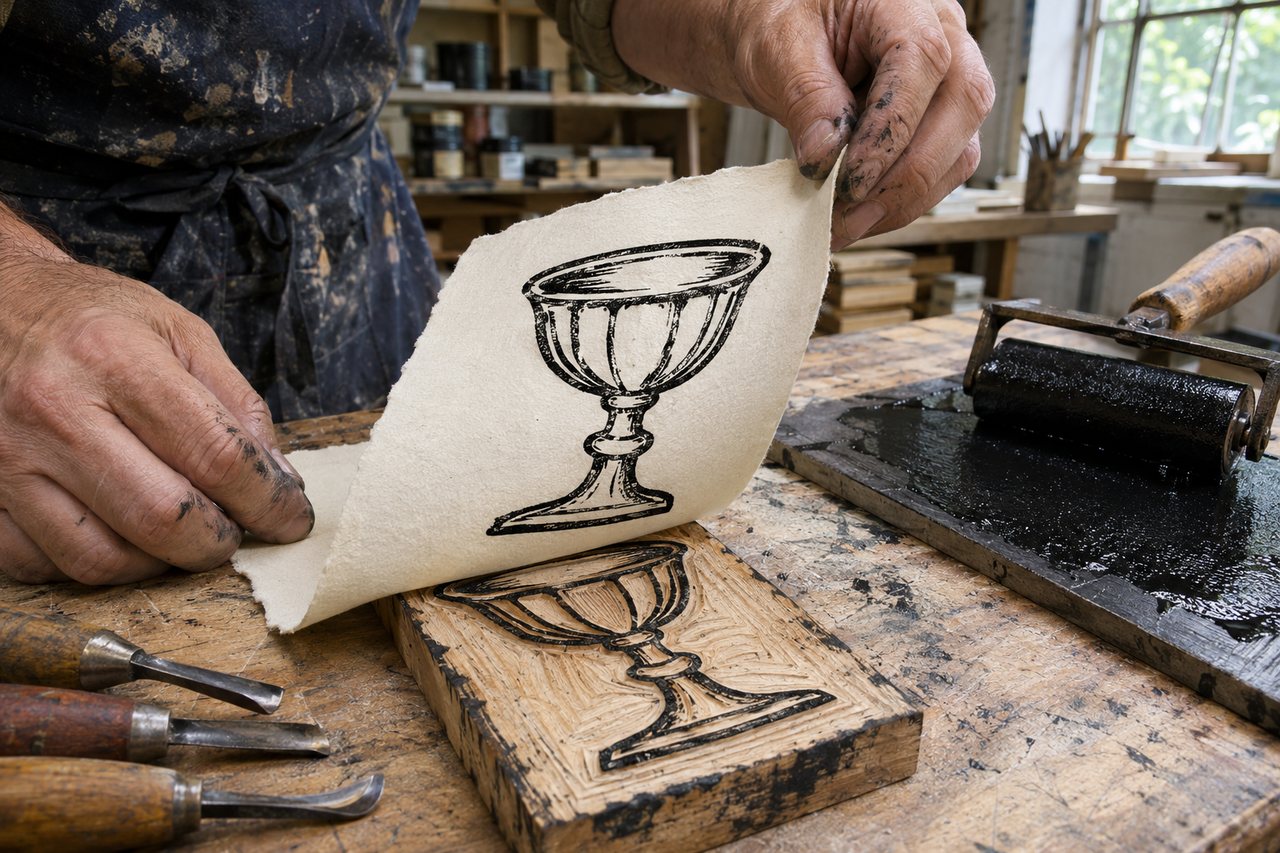
A tarot card reaches a reader as a finished image. Its black contours, coloured shapes and small irregularities seem to belong to one indivisible picture. In a printed card, however, they may record separate operations: a surface cut, ink applied, paper pressed, colour added and a sheet divided. Looking at those operations changes the questions we ask. Before wondering what a tiny mark means, we can ask how it arrived on the paper. The workshop is part of the card’s story, even when the workshop has disappeared.
The line begins with what the cutter removes
The V&A’s explanation of printmaking describes woodcut as a relief process. The maker removes material around the intended image, leaving a raised printing surface. Ink on that surface transfers to another material, usually paper. What appears as a black line in the impression may therefore correspond to wood deliberately left standing.
This differs from intaglio processes such as engraving, where ink is held in incised lines. A carved-looking image is not enough to identify which process produced it. Woodcut and engraving describe different arrangements of surface, ink and pressure, rather than two interchangeable names for old-fashioned printing.
For a reader, the useful change is to imagine the image as a set of making decisions. A narrow line must be supported by a printable surface. An open white area may be the result of material removed. The final black-and-white pattern is also a record of what the cutter chose to preserve.
That does not mean we can diagnose the manufacture of any card from a phone photograph. A modern reproduction may imitate the appearance of an older print. A label, catalogue record or publisher’s specification can tell us more than a confident guess based on texture alone.
One sheet, several cards
In the V&A’s reconstruction of early-Renaissance playing-card production, artist Anne Desmet demonstrates woodcutting and stencilling. The museum identifies its reference object as an uncut sheet by Gilles Savouré, made in France around 1490–1500. The resource concerns playing cards; it should not be relabelled as a surviving tarot sheet.
The museum emphasizes the economic importance of printing cards together from a block: repeatable production made them available to a wider audience than individually painted examples. A process that looks slow to us could still represent a substantial change in how images circulated.
A sheet also offers information that a loose card cannot. Imagine an invented workshop layout containing several card rectangles. Before separation, the rectangles have neighbours and shared margins. After cutting, each looks self-contained. The image has acquired an individual boundary even though it was produced within a larger arrangement.
That hypothetical comparison suggests a useful museum-viewing habit. If a catalogue shows an uncut sheet, examine the spaces between the pictures as well as the pictures themselves. Do not assume those spaces reveal a symbolic relationship between adjacent cards. They may be part of a production layout whose purpose needs separate investigation.
Colour is another operation
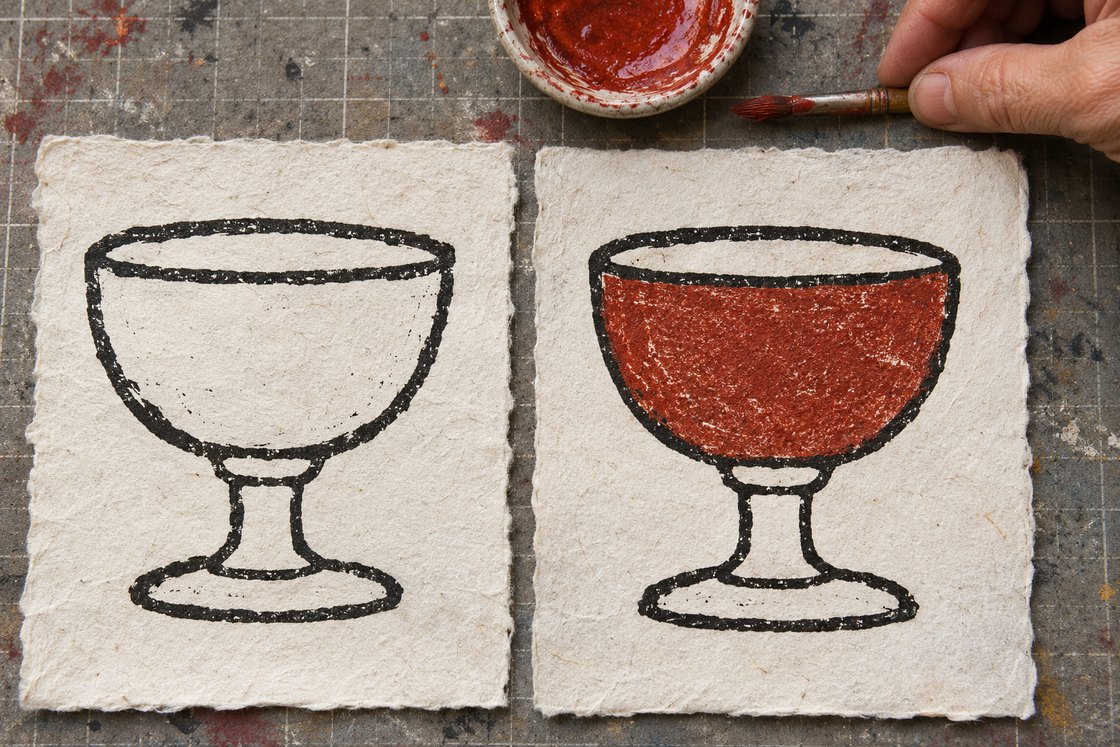
The V&A’s history of tarot cards includes a French Le Bateleur card dated to about 1750 and described as woodcut and colour stencilled. Alongside the museum’s workshop demonstration, this gives us a tarot-specific example of the combination. A stencil controls where colour can pass through an opening; the coloured area and printed contour belong to distinct operations.
This separation is easy to overlook when an image is small. A red shape may appear to be part of the same operation as the black edge surrounding it. Looking closely invites another possibility: a printed outline followed by a controlled application of colour. The museum’s explanation establishes the technique, not the manufacturing history of every red card.
Our generated workshop illustrations use a deliberately simple invented chalice motif to make those two operations visible. They are illustrative reconstructions of a demonstration, not photographs of an identified historical block or deck. The absence of titles and numbers avoids inventing inscriptions that might be mistaken for documentary evidence.
For symbolic reading, colour can still matter. A red vessel may draw your eye differently from an uncoloured one. But there are two questions here: how the colour was applied, and what association you choose to explore. An answer about technique does not decide the interpretation; an interpretation does not identify the technique.
A printing block can outlive its first job
A particularly revealing object appears in the Grolier Club’s presentation of a block from Rare Book School’s collection. The catalogue dates this woodcut block of three tarot cards to about 1700, gives its location as possibly France, and describes its style as reminiscent of the Tarot de Marseille.
The account suggests it may once have belonged to a larger block. It also records a second use: the wood became a cabinet door, with traces of hinge mounting along an edge. The object’s history did not end when its printing function ended.
The tentative language matters. “Possibly part of a larger block” is not a complete reconstructed sheet, and a questioned place of origin is not a firm attribution. Keeping the catalogue’s uncertainty visible makes the surviving evidence more useful, rather than less impressive.
The cabinet-door episode also changes what counts as a meaningful mark. A hole on the edge might belong to the object’s later furniture life, rather than its image-making life. The broader lesson is to ask which stage of an object’s history a feature belongs to before using it to explain another stage.
Read a small difference without making it an omen
Suppose you compare two reproductions of a similar card and notice that a coloured patch meets a black contour differently. That observation is worth recording. It is not, by itself, proof of a secret correction, an intentional code or a message aimed at the person looking today.
Begin with a precise description: the red extends beyond the left edge of the vessel in one image, while it stops inside the edge in the other. Then record what you actually know about the two images. Are they photographs of separate impressions, scans from different publications or modern redrawings? If you cannot establish that, leave the relationship unresolved.
A useful comparison keeps scale consistent. Zooming one reproduction much further than another can make a tiny feature seem disproportionately important. Cropped margins can also remove context. Preserve the full image and its catalogue information before building an explanation around a close-up.
Only after that descriptive work should you add a personal response. Perhaps the crossing of a boundary suggests a question about limits in your own life. That is an openly chosen metaphor. It need not become a historical claim about the printer’s intention or a prediction about what happens next.
Bring the maker back into view
A printed tarot card is both an image someone can interpret and an object someone had to make. Following its manufacture gives attention to the less theatrical decisions: which areas remain raised, how colour reaches paper, where one card ends and another begins, and what happens to a block after its working life.
These questions do not drain a card of meaning. They give meaning a more tangible setting. The next time a small irregularity catches your eye, pause before turning it into a sign. It may first be an invitation to notice a material, a process or a maker’s hand.
Sources and further reading
The four linked institutional resources support the explanations of printing, the playing-card demonstration, stencilling and the surviving tarot block. The comparison method and hypothetical workshop layout are original editorial guidance. Both images are original AI-generated photographic-style illustrative reconstructions; the inline comparison shows separate monochrome and coloured demonstration prints, rather than a stencil in use. Continue with how tarot pips become scenes or our Tarot Guides for reflective reading practices.