Divination History & Culture
Tea-Leaf Reading: How the Cup Shapes the Story

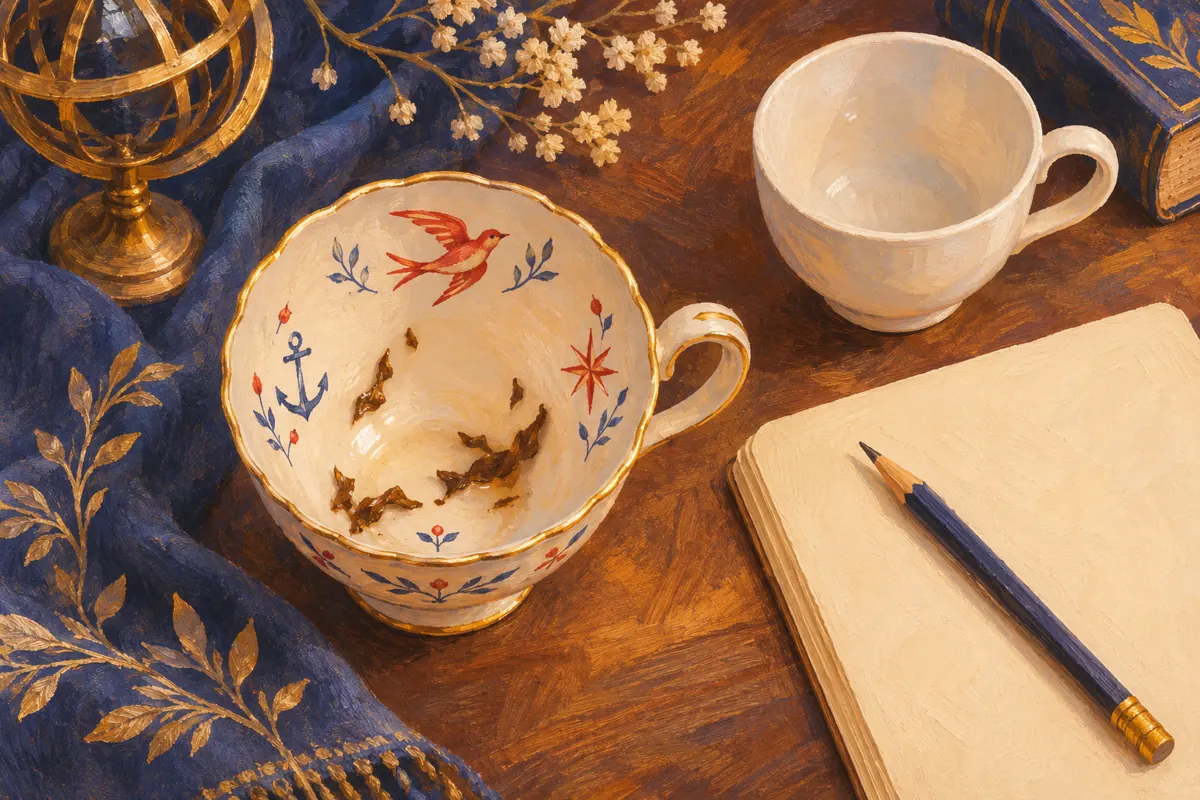
Before anyone names a symbol, there is a cup: its pale interior, its handle, the wet leaves caught along its sides. Tea-leaf reading turns these ordinary details into a setting for questions. Yet the cup itself can quietly influence the answer. A plain surface invites someone to discover a shape; a cup printed with pictures supplies a vocabulary in advance. Looking at surviving examples makes tasseography interesting as a practice of attention, conversation and design, without requiring us to mistake an evocative pattern for evidence of the future.
A history with an uncertain beginning
Tasseography is the interpretation of sediment left in a drinking vessel; tea-leaf reading is one familiar form. The Horniman Museum and Gardens’ introduction explicitly acknowledges uncertainty about where and when tea-leaf reading began. That qualification matters. The history of a drink and the history of a particular way of interpreting its remains are different subjects. Establishing that people drank tea does not establish that they performed the same ritual a modern reader describes.
There is therefore no need to give every cup a grand origin story. A documented manufactured object, a printed manual and an account of learning within a household can each tell us something narrower and more useful. They show particular ways the practice circulated, rather than proving a single uninterrupted tradition shared by everyone.
For this story, the strongest evidence is material: named cups with catalogue records and a dated book. These sources let us ask who supplied the symbols and how instructions shaped the experience. They do not establish that a reading predicted anything successfully.
The cup as a designed reading surface
The Museum of Witchcraft and Magic identifies its object 336 as an Aynsley Nelros Cup of Fortune, dated 1904–1908. Its saucer carries zodiac signs; inside the cup are planetary signs and pictorial motifs in red and black. This is a specific early twentieth-century object, not a generic illustration of how all tea readers worked.
A second record, object 3245, describes another version of the Nelros design. Among its motifs are a horseshoe, letter, goblet and cat, alongside celestial symbols. Seeing familiar objects next to planetary signs gives the reader several possible languages at once: everyday associations, learned symbolism and the relationships created by the cup’s layout.
Our editorial interpretation is that decoration changes the task. On an undecorated surface, a person must first decide whether a cluster resembles anything. On a printed surface, a leaf can appear beside a recognizable motif that was present before the tea was poured. Those are different routes to meaning. Neither is automatically more authentic, but recording which kind of cup was used helps explain how a reading took shape.
This also complicates the idea of a completely spontaneous message. A manufacturer has chosen the printed pictures, their size and their placement. The cup is participating in the conversation before the reader speaks. Its design deserves attention alongside the leaves.
Instructions do not erase the reader
A Paragon cup in the same museum, object 1398, is dated to the 1930s or 1940s. Its pink decoration and gold edging place fortune-telling inside an attractive domestic object. The catalogue also preserves a visitor’s family account: a great-grandmother working in service learned tea reading from another servant, but later relatives did not find themselves able to interpret it.
That is a reported family recollection, not a controlled test or a complete social history. Even so, it introduces something the ceramic alone cannot show: learning may have involved another person’s demonstration, encouragement and expectations. Owning a decorated cup was not necessarily experienced as equivalent to knowing how to read it.
We can take that distinction seriously without deciding that an inherited supernatural gift explains it. A manual can list associations while leaving open how to choose among them, how much detail to notice and how to connect the result to a question. Different people can respond differently to the same materials. The account is valuable precisely because it preserves that unevenness instead of smoothing it into a universal rule.
One shape can carry more than one story
The British Library’s record for a 1920 edition of Tea-Cup Reading and the Art of Fortune-Telling by Tea-Leaves, credited to “a Highland Seer,” gives a revealing example. In that book, a dog near the top of the cup receives a favourable association with a loyal friend. The Library contrasts this with the threatening dog imagery used in the fictional world of Harry Potter.
The useful lesson is not to replace a frightening dictionary with a reassuring one and call the problem solved. It is to identify the dictionary being used. “I see a dog” describes a resemblance; “this dog means friendship” applies a convention. A prediction about someone’s actual friend adds another claim again. Moving between these sentences can feel effortless, but each step changes what is being asserted.
The same issue arises when reading illustrated cards. Our story on tarot pips and scenes explores how an image directs attention before interpretation begins. A tea cup differs because the leaves move and settle, yet both settings invite a story from selected details.
A small exercise in comparing readings
If you want to explore the practice reflectively, begin with a photograph of a cooled cup rather than a list of omens. Record only visible features: a curved line, three separate clusters, an open patch. Avoid naming animals or events in this first description. The point is to preserve what you noticed before a symbolic explanation begins to feel inevitable.
Next, write two possible resemblances for one cluster. An arc might suggest a bridge to one viewer and a crescent to another. These are invented examples, not fixed tea-reading rules. Keeping both possibilities makes the act of selection visible. If a companion is involved, let each person write independently before comparing notes.
Then identify the source of any meaning you attach. Did it come from a named manual, something learned from a relative, or a personal association? Try a hypothetical bridge: it might prompt a question about reconnecting with someone or moving between projects. That can become a useful conversation without becoming a claim that a particular message or journey is destined to occur.
Finish with an action you could justify independently of the cup. You might contact a friend because you value the relationship, or clarify a project because its next step is unclear. The reading has then supplied a prompt, while your reasons remain available for ordinary discussion. If you return to your notes later, preserve the original wording rather than rewriting it to fit what happened.
What remains after the tea
Surviving fortune-telling cups show how a household object can become a portable symbolic world. Manufacturers supplied pictures; manuals supplied conventions; readers and companions supplied attention and conversation. The interest lies in the interaction among them.
A careful encounter with tasseography can appreciate the craft of a cup, the history of a particular object and the imaginative pleasure of finding a shape. It can also leave the future unresolved. The question worth carrying away is not simply “What did the leaves say?” but “How did we arrive at that reading?”
Sources and further reading
The five linked institutional records above support the historical descriptions. The design comparisons and reflective exercise are original Precise Arcana editorial analysis, not evidence of predictive effects. The illustrations are newly generated conceptual scenes, not photographs of the catalogued objects. For related approaches to symbolic reading, explore our Tarot Guides.