
Tarot Practice & Reading Methods
Shuffling a Tarot Deck: Order, Orientation and the First Draw
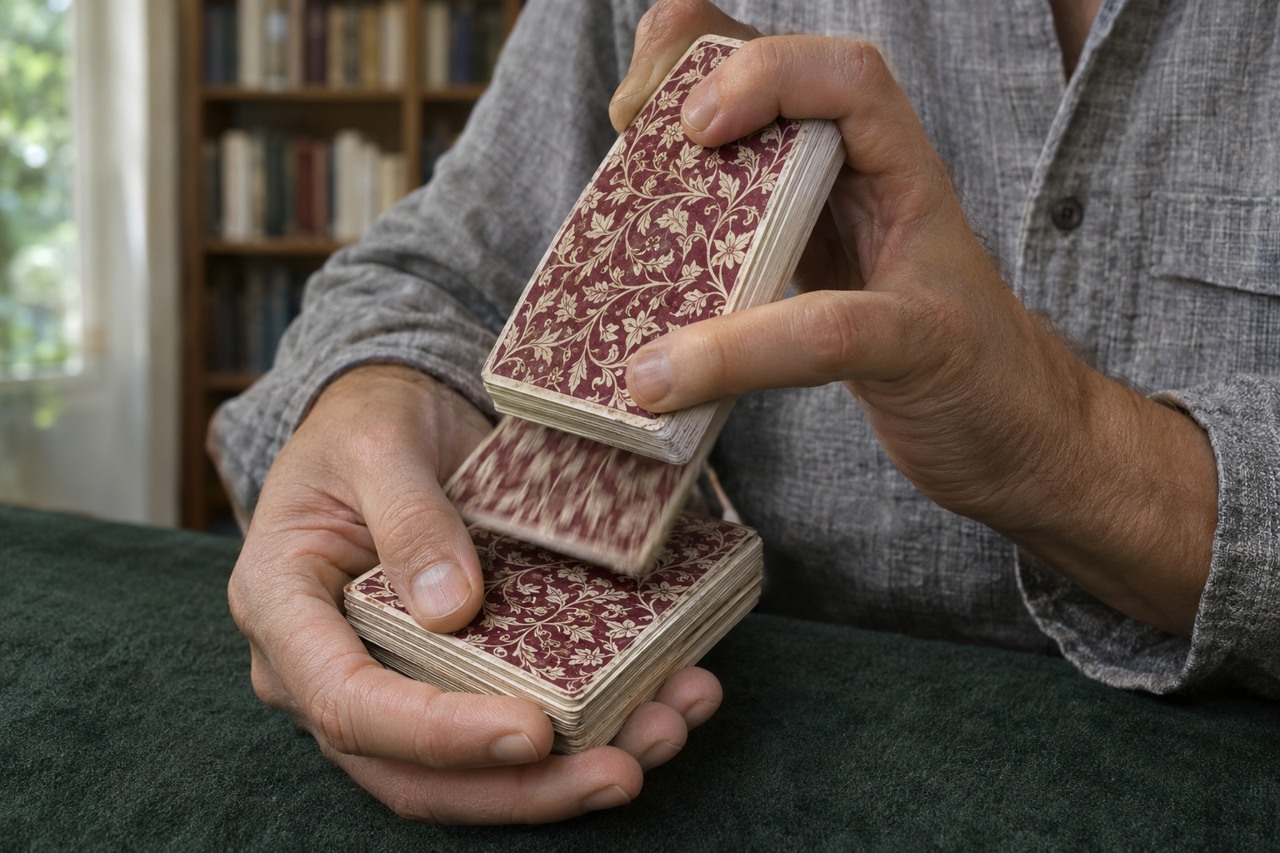
The reading begins before a card is face up. Someone squares the deck, mixes it, pauses and chooses where the first card will come from. Those movements can feel reassuringly familiar, yet each does a different job. Moving cards changes their arrangement. Turning a packet changes its orientation. A pause can mark the moment when a question is settled. Looking at those jobs separately makes it easier to build a tarot practice that is comfortable, consistent and open to reflection, without making the handling of the deck into a test that a reader can mysteriously fail.
What are you asking the preparation to do?
Imagine two readers preparing the same deck. One wants to interrupt the order left by the previous spread. The other wants a quiet minute to decide what to ask. Both may shuffle, but success means something different to each. The first concern is about cards moving through a pack. The second is about attention.
A useful preparation can serve both purposes. It helps to name them before deciding how to proceed. “I want the old spread broken up” suggests checking that packets actually change places. “I need to settle my question” suggests a pause long enough to write that question clearly. Neither aim requires a promise that a particular movement reveals an objectively correct future.
Try beginning with a question whose answer can lead to a decision. For an unfinished creative project, that might be: “What deserves attention before I choose the next task?” Decide what the spread positions will ask, then prepare the cards. This makes the reading a structured encounter with images rather than an attempt to discover the question after seeing a striking result.
A historical instruction contains several choices
In S. L. MacGregor Mathers’s account of tarot divination, preparation includes changing the cards’ sequence and turning some upside down, followed by cutting. He also prescribes concentration on the inquiry and repetition of the procedure. These are instructions within his divinatory practice, including his claims about how that practice works.
A. E. Waite’s alternative reading method similarly calls for mixing the pack, inverting some cards and having the person asking the question cut it with the left hand. His text then describes a particular dealing procedure. It documents a specified method, rather than a universal rule binding every modern reading.
For a reader today, the valuable distinction is between following a tradition deliberately and treating every detail as a condition of personal worth or competence. You can say which method you are using, adapt it for your hands and cards, and explain the adaptation. The historical texts establish what their authors instructed. They do not demonstrate that using a particular hand improves predictive accuracy.
A cut preserves more than it changes
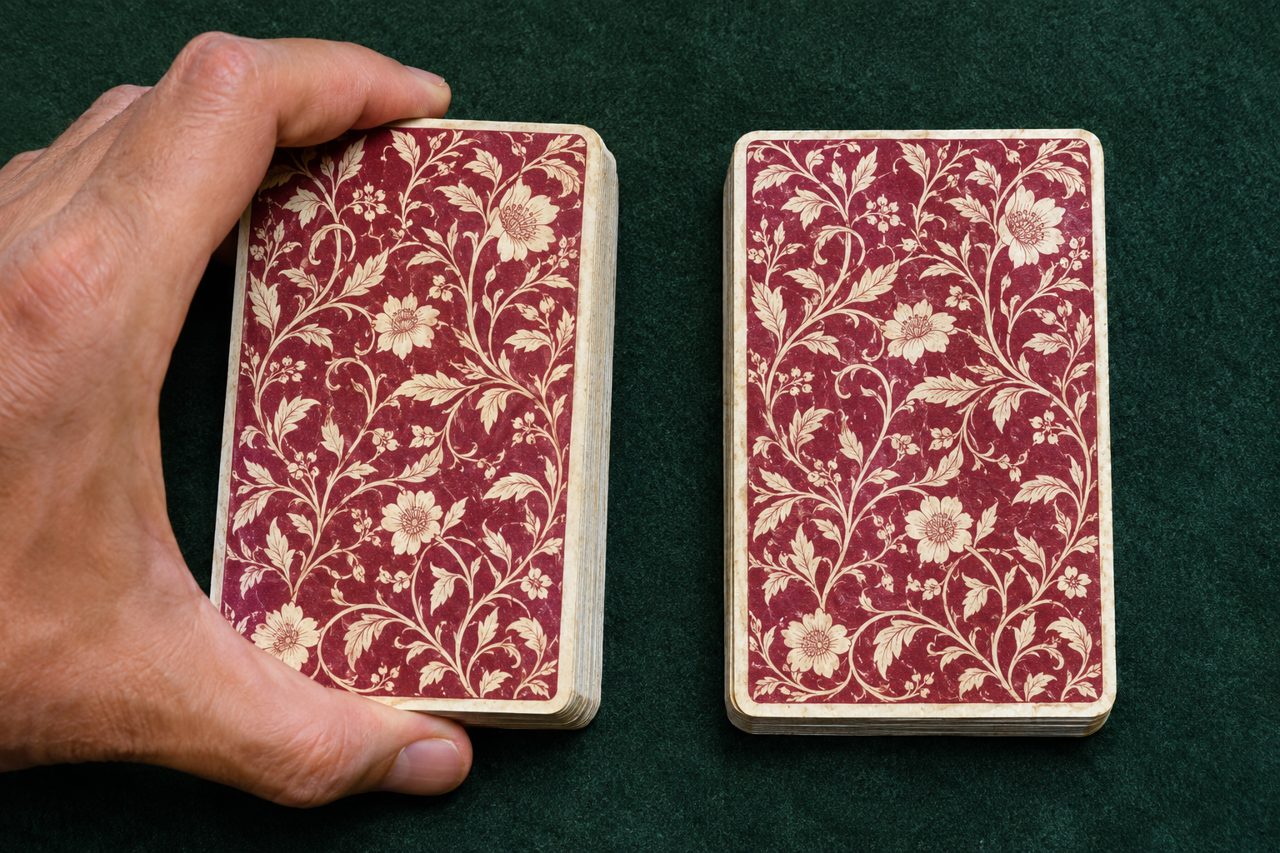
Consider four cards in the order A, B, C, D. Lift A and B as one packet and put that packet beneath C and D. The result is C, D, A, B. The starting point changed, while the order within each packet survived. B and C still meet if the sequence is imagined as a circle, and so do the other neighbouring pairs.
This miniature example explains why a simple cut and a thorough mixing procedure are different operations. A cut can hand the final choice of starting point to another person. It can also mark a transition between preparation and drawing. Those are clear roles even though a single cut does not explore every possible arrangement of the cards.
For a practical reading, decide how the cut will be reassembled before doing it. If you use two packets, know which goes on top. If another person is involved, explain the choice without making them worry about selecting the “wrong” packet. Once the deck is reassembled, move on to the agreed draw.
Why seven is not a universal shuffle instruction
Advice about shuffling often borrows a famous result from playing-card mathematics. Harvey Mudd College’s explanation of the seven-shuffle result describes a model of random riffle shuffling for 52 cards and emphasises that the answer depends on the kind of shuffle and the mathematical measure used. It cites Bayer and Diaconis’s work.
That setting matters. A riffle interleaves two packets. An overhand shuffle transfers packets from one hand to the other. A tarot pack can also have a different number of cards from the playing-card pack in the familiar result. Repeating the number seven while changing the deck and procedure does not reproduce the conditions of the mathematical statement.
There is another difference between an arrangement and the process that produces it. A surprisingly neat run of cards is possible after random mixing. Seeing one does not, by itself, establish that the mixing failed. Equally, an untidy-looking arrangement is insufficient evidence that all possible orders were equally likely.
A personal routine can be repeatable without claiming laboratory certification. Choose a handling method you can perform comfortably, allow packets to change places, and avoid repeatedly restarting because the deck does not yet feel destined to give a preferred answer. A special count can remain part of a chosen ritual if you describe it that way.
Reversals need a decision of their own
Order and orientation can change independently. If every packet stays facing the same way during mixing, the cards can exchange positions without any becoming reversed. Turning an entire squared deck end for end changes every card’s orientation together, rather than independently selecting which ones will be upright.
If your reading uses reversals, decide how you will introduce and read them before drawing. Also decide how to turn a selected card face up. Different turning movements can alter which edge finishes nearest the reader. Practise the movement with a familiar card so that handling does not quietly determine an interpretation you attribute to the draw.
Readers who work entirely upright can state that convention just as clearly. A reversal is an interpretive feature of a method. Its presence is not an automatic instruction to turn every encouraging association into a threat. Our guide to reversed tarot cards explores that interpretive question in more detail.
Choose a stopping rule before an interruption
A card slips from a packet. Several fall onto the mat. The moment may feel charged because it interrupted a deliberate action. Before starting, decide how you will handle such events. One straightforward option is to return accidental drops to the deck and continue. Another is to record a fallen card separately as an optional reflection prompt, while keeping the planned spread intact.
These are suggested conventions, not claims about what a falling card means. What matters is avoiding a rule that changes only when the exposed image is appealing or alarming. If you choose to include accidental cards, consider in advance how you will handle several at once and whether they replace or supplement the planned draw.
Then set a boundary around the reading itself. For the creative-project question, draw the agreed cards, make an initial interpretation and identify one manageable action. If you later want clarification, write the narrower question first. Repeatedly dealing until a satisfying answer arrives can conceal how much selection has shaped the result.
A routine you can explain
A simple preparation might therefore run as follows. Write the question and position prompts. Decide whether reversals and accidental drops belong to the method. Mix the deck using a comfortable movement, cut if you wish, and draw from the location agreed beforehand. Record the spread before interpreting it.
Afterwards, evaluate the action the reading helped you choose. Did it clarify the project’s next step? Did it expose a concern you had been avoiding? Those questions let a symbolic practice contribute to reflection while keeping responsibility for decisions with the person making them.
The preparation becomes useful through its clarity. You can explain which movements change the pack, which conventions organise interpretation and which moments help you concentrate. That leaves more attention available for the cards themselves, and less for worrying that an unfamiliar shuffle has invalidated the conversation.
Sources and further reading
The linked Mathers and Waite texts document their respective instructions. The Harvey Mudd resource supports the limited discussion of shuffle mathematics. The four-card example, handling routine and creative-project prompts are original editorial suggestions. Both images are original AI-generated photographic-style illustrations of imagined modern card handling, with invented patterned backs. Continue with our three-card spread guide or browse Tarot Guides.