Tarot History & Culture
Tarot Began as a Game: What Its History Teaches a Modern Reader
A tarot deck can look like a book of mysteries: a traveller, a ruler, a turning wheel, a tower, the sun. Yet its documented early life belongs to the world of games. Understanding that history does more than correct an origin story. It offers a useful way to read today: notice relationships between cards, respect the particular deck in front of you, and distinguish an invitation to reflect from a claim about what must happen.
What the historical evidence actually tells us
The Metropolitan Museum of Art places early references to tarot in northern Italy in the mid-fifteenth century. Its account describes suit cards accompanied by a Fool and a set of trumps, used in a trick-taking game. Surviving luxury decks are evidence of a material culture of painting, patronage and play, rather than proof of an unchanged system of divination stretching into antiquity. The Met’s history and structure of tarot is a useful starting point for that distinction.
This does not mean every question about tarot’s beginnings has been settled. Objects survive unevenly; documentation can identify a practice without explaining every image. The responsible response to a gap is to name it. A compelling story about a symbol is not automatically evidence of where that symbol originated.
There is also a difference between a history of playing cards generally and a history of tarot specifically. An earlier example of cards elsewhere does not, by itself, establish that the familiar tarot sequence already existed there. When comparing traditions, ask what the source actually documents: an object, a named game, a particular deck, or a later interpretation.
A later tradition can still be meaningful
The Victoria and Albert Museum describes the growth of tarot divination in the late eighteenth century and its subsequent occult development. It also notes that claims of Egyptian origins remain unproven. These are historical distinctions, not a test of whether a modern reader is allowed to find the cards meaningful. The V&A’s illustrated history places different decks within that changing context.
A tradition can acquire a new purpose without becoming worthless. A familiar melody can carry different meanings in a ceremony, a concert and a family memory. Similarly, a picture first encountered in a game may later support a conversation about responsibility, loss or renewal. What matters is being honest about which kind of claim you are making.
“This image helps me think about a transition” is an interpretation. “This deck began in this place and century” is a historical claim. “This card proves an event will occur” is a prediction requiring evidence that a symbolic reading cannot supply. Keeping those sentences separate allows curiosity without turning uncertainty into authority.
Why the deck works better as a conversation than a dictionary
A game makes the significance of a card depend partly on other cards and the situation in which it is played. Modern reflective reading is a different activity, but that relational quality offers a useful analogy. The question, position and surrounding images can change the emphasis of a card. They need not change it into an entirely unrelated message.
Consider The Fool beside The Emperor. One possible reading explores the relationship between experimentation and structure. It is less useful to declare that one card means freedom and the other means control, then choose a winner. A project might need both a first attempt and a realistic boundary.
That is Precise Arcana’s practical interpretation of the pairing, not a claim about how Renaissance players understood it. To make it concrete, ask: what could I try safely, and what limit would make that experiment sustainable? The answer should emerge from your circumstances. The cards help frame the question; they do not know your budget, obligations or other people’s intentions.
Structure is useful without being a prediction machine
The familiar 78-card arrangement combines four suits with a separate group commonly called the Major Arcana. The Met’s account explains the historical structure of suit cards and trumps. Today, a reader can use that structure as a way to organize attention rather than as a guarantee that experience will unfold in a fixed sequence.
Our Major Arcana guide explores broader themes, while the Minor Arcana guide considers everyday situations. Neither division means that a difficult Major Arcana card must announce a dramatic event, or that a suit card describes something trivial. Scale depends on the actual question.
In a career reflection, for example, a broad theme of change becomes useful when connected to a smaller action: documenting a skill, asking a clear question at work, or checking the terms of an opportunity. A symbolic idea becomes less useful when it grows so grand that no ordinary action can answer it. Bring the interpretation back to something observable.
Look at the artwork before importing a meaning
Decks do not all tell their stories in the same visual language. The V&A highlights Pamela Colman Smith’s contribution to the illustrated Minor Arcana of the Rider–Waite–Smith deck. That attention to pictured situations helps explain why looking closely can matter as much as remembering a keyword. It does not make every later deck interchangeable with that one.
Begin with what you can actually see. Where does a figure look? What is being held, shared, defended or left behind? Is the scene crowded or solitary? Then compare those observations with the deck’s own explanation. This protects the reading from a common shortcut: announcing a memorized answer before noticing the image.
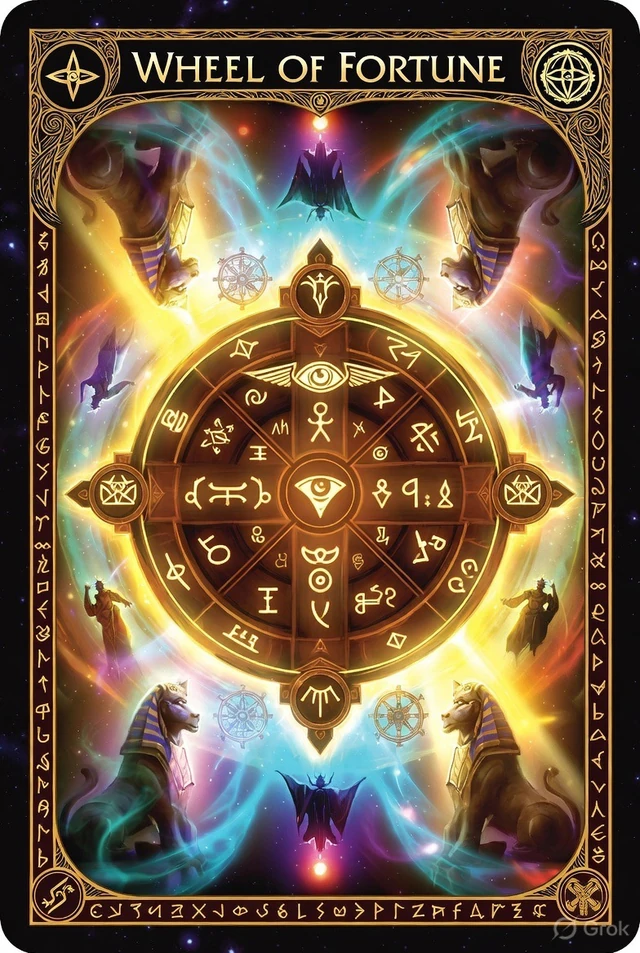
The Wheel of Fortune makes a useful exercise. Treat movement and changing conditions as themes to investigate, rather than promising that luck will improve. Ask which circumstances you can influence and which require adaptation. Different artwork may suggest a different emphasis, while the practical question remains open.
A three-card exercise grounded in your actual situation
Choose a modest, open question: “How can I approach this decision more thoughtfully?” Avoid asking the spread to reveal private facts about somebody else or to replace information you could check directly. Our question-writing guide offers more examples of prompts that preserve your agency.
Use the Past, Present and Future spread as a framework for reflection. In the Past position, identify a pattern you already recognize. In the Present position, name a choice or tension that exists now. In the Future position, explore a possible direction if that pattern continues, rather than declaring a result inevitable.
Write one observation about each image before writing an interpretation. Next, connect the three observations in a short paragraph. Finish with one action and one uncertainty. For example: “I will ask for clarification about the role; I still do not know how the team handles deadlines.” Keeping the uncertainty visible is part of a careful reading, not a failure of it.
Conclusion: history creates room for a more careful practice
Tarot’s game origins do not tell us that every contemporary use is mistaken. They remind us that the cards have lived in more than one context, and that interpretation changes with people, pictures and purpose. Historical evidence deserves accurate attribution; symbolic practice deserves a clear statement of its limits.
You do not need an invented ancient pedigree to ask a worthwhile question. Start with the artwork, consider the relationships between cards, and translate the reading into a practical choice you can assess. When a decision concerns health, money or another person’s consent, rely on appropriate evidence and expertise. Let tarot contribute reflection, while real-world information remains the basis for consequential decisions.
Sources and further reading
Historical research: Tim Husband, The Metropolitan Museum of Art, “Before Fortune-Telling: The History and Structure of Tarot Cards”; Victoria and Albert Museum, “A history of tarot cards”. The exercises and comparisons above are original Precise Arcana interpretations, not museum claims.