Numerology, Mathematics & Nature
Fibonacci Sunflowers: Counting Before Meaning
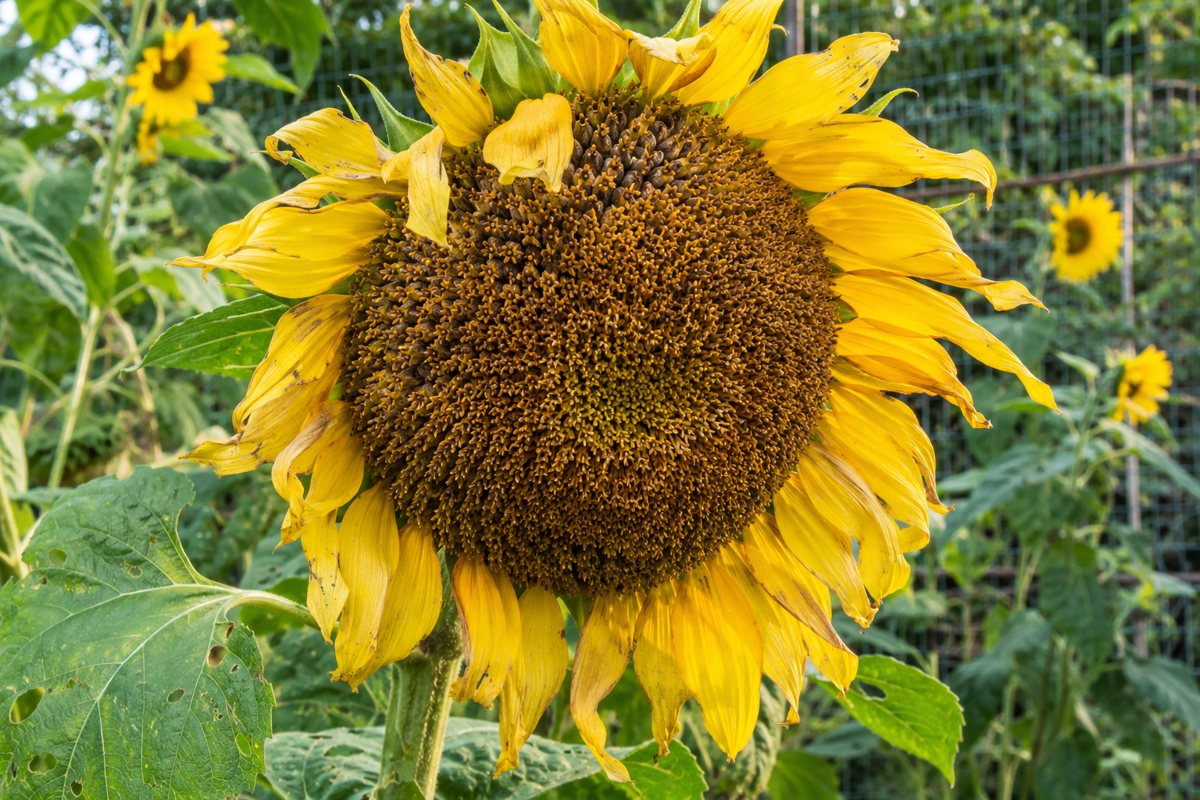
A sunflower can make arithmetic look alive. Curved rows seem to cross its face in opposite directions, and a familiar number sequence often appears when people count them. For anyone drawn to numerology, that combination is irresistible. Here is a pattern that can actually be examined. Yet the most interesting question comes before assigning it a meaning. What exactly are we counting, and what would persuade us that our first impression was wrong? A flower offers a useful exercise in attention precisely because it can resist the tidy story we bring to it.
Begin with a rule you can reproduce
Start with one and one. Add the latest two numbers to obtain the next. Continuing gives 1, 1, 2, 3, 5, 8, 13, 21 and 34. That is enough to generate the familiar Fibonacci sequence without a flower, a personality profile or an interpretive tradition. Anyone following the same starting values and addition rule can check the result.
Consider a small copying mistake. If someone writes 22 after 13, the written row may still look like an impressive progression. Checking the operation reveals the error immediately. Thirteen plus eight gives twenty-one. The appearance of a meaningful series cannot substitute for the rule that produced it.
This gives us a first distinction to carry outdoors. A sequence on paper is generated by arithmetic. A pattern in a plant must be observed. Finding a connection between them requires an account of the observation, rather than simply placing the sequence beside an attractive photograph.
The curves our eyes trace
Smith College’s phyllotaxis resource explains the repeating arrangements of plant organs and the opposing families of curves called parastichies. Its examples include a sunflower with 34 curves in one direction and 55 in the other, and a pinecone with counts of eight and thirteen. Each pair consists of neighbouring Fibonacci numbers.
A curve here connects neighbouring elements across the surface. It is different from counting every seed. Those two procedures could both produce numbers, but they answer different questions. A statement that a head has a particular number of spirals should therefore specify the direction and the family of curves being followed.
Try describing a picture without using the word Fibonacci. You might record that curved rows cross, that some rows are easier to follow near the edge, or that an irregular patch interrupts a possible route. Such a description preserves the visible evidence before a famous label begins organising it.
That habit is valuable in symbolic reading too. Naming a motif can help us notice something, but it can also steer attention away from details that do not fit. Description gives those details a place to remain.
The flowers that complicate the picture
A 2016 citizen-science study by Jonathan Swinton and colleagues, published in Royal Society Open Science, collected data on 657 sunflowers. In its most reliable subset, 565 of 768 directional spiral counts were Fibonacci numbers. The authors also reported other structures and heads for which a definite count could not be assigned.
The study’s published paper treats variation as evidence relevant to explanations of plant patterning. Its results give us a richer question than whether one photograph can be made to resemble an ideal. How often does a proposed relationship occur, and how should observations that differ be recorded?
Notice the unit in the figures above. The 768 observations are directional counts, rather than a claim that the study found 768 separate flowers in that subset. Even an accurate number can mislead when its unit drops out of the sentence.
For a personal observation, a difficult head need not be forced into a single answer. “I could not count this reliably” is a result worth keeping. It tells a later reader where the evidence ends and where a new photograph, another observer or a clearer procedure might help.
A counting session that allows disagreement
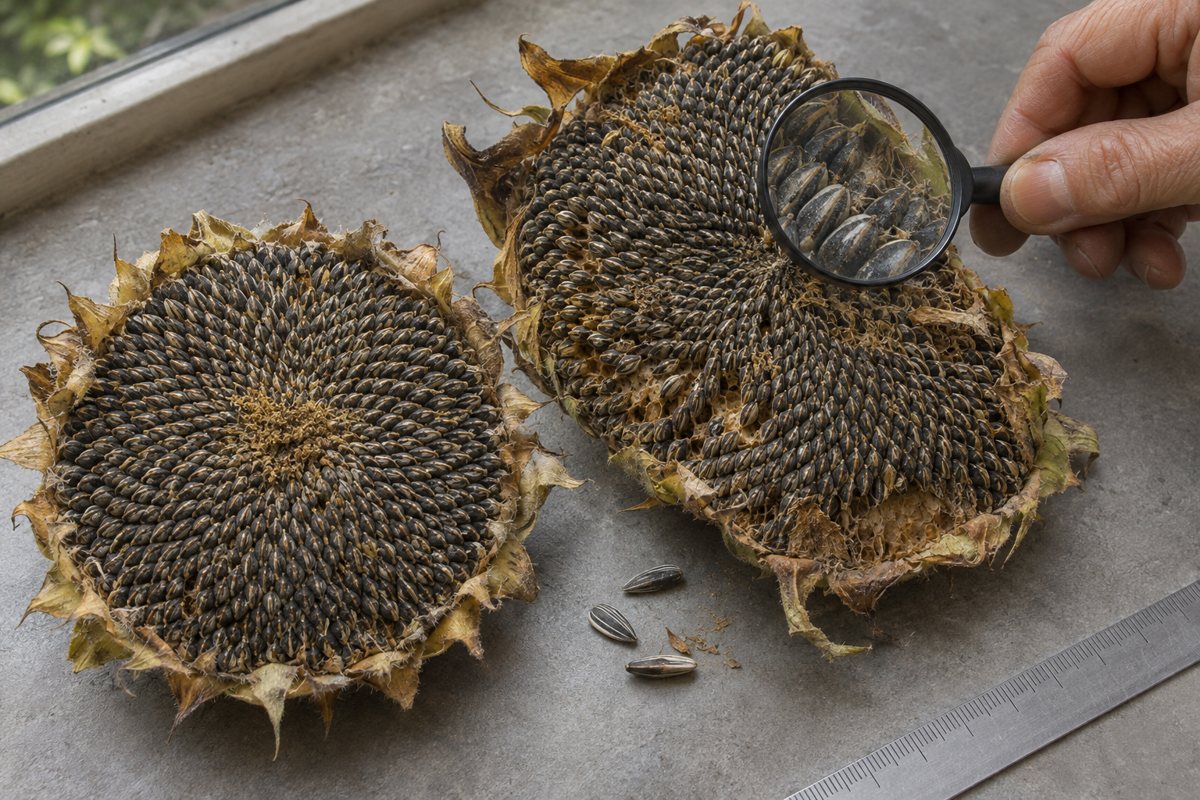
Use a real sunflower head or a clearly documented photograph of one. Choose material you can examine without damaging someone else’s garden. The generated images accompanying this article illustrate the subject; they are unsuitable as measured specimens or proof of exact spiral counts.
Before counting, record the region you intend to inspect and the direction you will follow. Work from a copy of a photograph if you want to trace lines. Use a consistent boundary, and mark where the counting begins so that a circuit does not quietly include the starting line twice.
Make a first pass without consulting a list of target numbers. Then stop and write down the result, including any uncertain branching points. Only afterwards compare it with the sequence. If a second pass gives a different answer, retain both attempts and explain which decision changed.
Ask another person to count independently before sharing your answer. Agreement is useful, but disagreement can expose the precise place where the method needs improvement. One observer may have followed a row through a gap that the other treated as a break.
Repeat the exercise on another head, including an awkward specimen. Choosing only the cleanest example would answer the narrower question of whether an appealing illustration can be found. A broader claim needs room for examples selected without knowing their outcome.
When a number becomes a personal symbol
A measured pattern can prompt reflection without deciding a person’s future. Someone might use the recurrence rule as a metaphor for how current work grows from earlier efforts. That is an interpretive choice. The botanical observation does not establish that the same rule governs their relationships, income or life events.
To make the choice explicit, write three short entries. First describe what you observed. Next record the mathematical relationship you checked. Finally state the association you would like to explore. For example, a repeated curved arrangement might suggest returning to an unfinished project with greater care. The proposed action belongs to your circumstances and judgment.
Keep that action testable in ordinary terms. “Spend twenty minutes reviewing last week’s unfinished task” identifies something you can do and evaluate. A promise that a particular number guarantees success bypasses the decisions that would actually influence the project.
Readers using numbered tarot cards can apply the same discipline. The number printed on a card, the method used to combine numbers and the interpretation given to a result are distinct parts of a reading. Our tarot and numerology guide offers a related place to explore those interpretive practices. A sunflower count cannot settle which convention a reader should adopt.
Let an exception improve the question
There is no need to choose between enjoying a pattern and examining it carefully. Looking for irregularities can make the experience more absorbing. Instead of asking only whether the expected number appears, ask where the rows become difficult to follow and which observations survive a change of observer.
The same approach can improve a journal of symbolic readings. Preserve the interpretation made at the time, then record what happened without rewriting the original note. Include occasions when an association proved unhelpful. A record that preserves disappointment is more informative than a collection containing only satisfying matches.
The sunflower’s contribution is a practice of attention. Arithmetic supplies a reproducible sequence, observation supplies particular counts, and reflection supplies a chosen association. Keeping track of how each statement was reached lets curiosity continue even when a flower refuses to supply the expected answer.
Sources and further reading
The linked Smith College resource supports the explanation of phyllotaxis; Swinton and colleagues’ paper supports the study findings. The counting exercise and reflective examples are original editorial suggestions. Both accompanying images are original AI-generated photographic-style botanical illustrations, rather than research photographs. Continue with zero, notation and historical evidence or explore Tarot Guides.