Death tarot meaning
Death concerns an ending that changes the shape of life. Its focus is the difficult work of acknowledging what has finished so that energy can stop being spent on preserving an exhausted form.
Key themes
Transition, endings, release, renewal.
Upright meaning
Upright, name what is no longer viable and consider a respectful closure. Renewal does not require pretending the ending is painless; grief and relief can coexist.
Reversed meaning
Reversed, resistance may be prolonging a transition, or an internal change may not yet be visible. Identify what you fear losing and what support would make release more manageable.
Love and relationships
In relationships, the card may describe a pattern that must end rather than the relationship itself. Honest change requires more than promising to repeat the same arrangement differently.
Career and work
At work, an old role, method or professional identity may need to be retired. Preserve useful experience while allowing its application to evolve.
Money and resources
For money, review commitments that belong to a past phase. Closing an unnecessary expense can be practical, but the card does not predict financial collapse.
Spirituality and personal growth
Personal growth involves making room for a changed self. Rituals of closure, reflection and patient adjustment can help you honor the past without remaining governed by it.
Traditional Rider–Waite–Smith symbolism
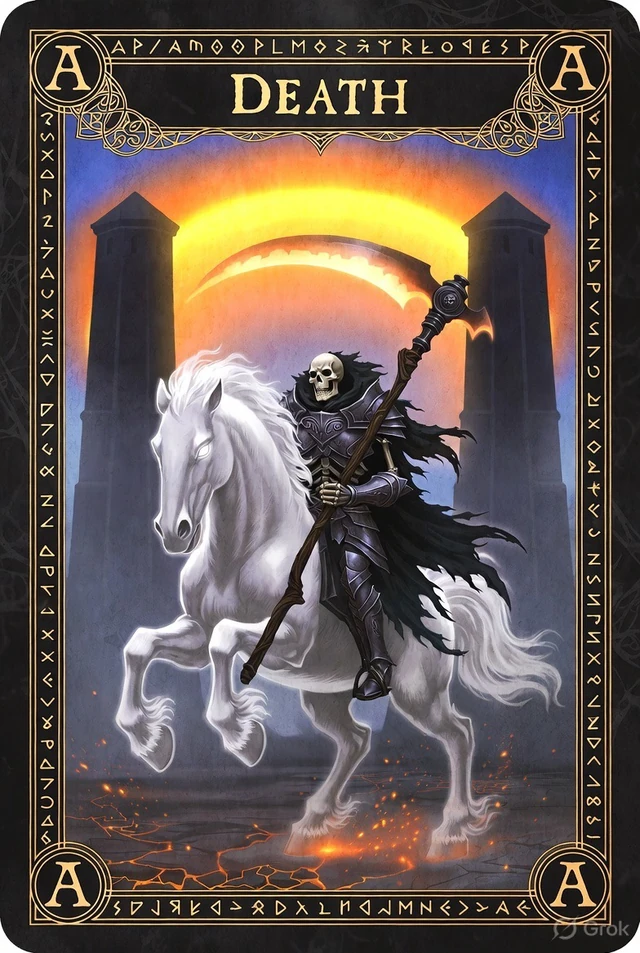
Traditional imagery shows an armored skeleton, a banner and figures of different stations, with light on the horizon. The scene emphasizes change that status alone cannot prevent.
Reflection and FAQ
What am I maintaining after its purpose has ended?
Does Death predict physical death?
No. Tarot cannot establish such an event; this card is commonly explored as a symbol of transition and release.
Consider how this theme changes in the Past, Present or Future position. A card is a prompt for reflection, not a fixed prediction.
Try a free three-card tarot reading