Numerology History & Symbolism
The Tetractys: Ten Points and a Question of Evidence

Ten small stones fit inside a triangle: one in the first row, two in the next, then three and four. The arrangement is easy to make, yet it can carry an unexpectedly large story. Known as the tetractys, or tetraktys, it belongs to the history of Pythagorean number symbolism. Looking closely at it reveals several different things at once: a count, a shape, relationships between numbers and a tradition whose surviving evidence needs careful handling. Its fascination begins when we ask how those things became connected.
Build the triangle before reading its meaning
Start with ten identical counters. Arrange them in four centred rows containing one, two, three and four counters. The sum is 1 + 2 + 3 + 4 = 10. The arrangement gives that addition a visible structure: each row extends the preceding one by a single counter. Nothing supernatural is needed to check either the total or the rule.
Cambridge’s NRICH explanation of triangle numbers connects sums of consecutive whole numbers with triangular arrays. Ten is one member of that larger family. Continue the same construction with a fifth row and the total becomes fifteen. The four-row triangle is therefore a stopping point within a pattern, rather than the only complete shape the pattern permits.
Now rearrange the same counters into two rows of five. Their number has not changed, but their relationships look different. The triangle emphasized successive growth; the rectangle emphasizes equal groups. Place them in a ring and another reading becomes available. These are observations about presentation, not competing discoveries about what ten secretly intends.
That small experiment is useful for anyone interested in numerology. Before assigning an association to a number, ask whether you are responding to its quantity, the way it has been arranged or a meaning supplied by a tradition. The same counters can answer all three questions, but the answers do different work.
The name does not settle the history
Carl Huffman’s Stanford Encyclopedia of Philosophy entry on Pythagoras explains a central difficulty: Pythagoras left no writings, and the surviving accounts are separated from his lifetime by substantial gaps. Later admiration also attributed ideas and achievements to him that cannot simply be accepted as contemporary testimony.
The entry describes a scholarly disagreement about the tetractys itself. One reading connects it with early Pythagorean teaching through material preserved by Iamblichus and thought to derive from Aristotle. Another questions whether the relevant passage was a later addition. That disagreement affects how confidently the symbol can be assigned to Pythagoras personally.
A careful label is therefore valuable. “A symbol associated with Pythagorean tradition” does not require the stronger claim “a diagram personally taught by Pythagoras in exactly this form.” Nor does an ancient association establish that a modern birthday or name-calculation system descends unchanged from his teaching. Such a connection would need its own documented history.
Uncertainty here makes the subject more interesting. Instead of imagining one teacher handing down an untouched package, we can ask how later communities selected, explained and authorized a memorable numerical form. A tradition can have a substantial history even where its earliest chapter remains disputed.
Four numbers can describe relationships
The appeal also reaches beyond a total of ten. Huffman’s companion entry on Philolaus discusses the musical concords associated with the ratios 2:1, 3:2 and 4:3: the octave, fifth and fourth. It also notes that familiar stories crediting Pythagoras personally with their discovery are unreliable. The relationships and the discovery legend should not be treated as one claim.
Notice what the ratios share. Every number needed to write them occurs among one, two, three and four. The attraction is no longer just addition. A compact set of whole numbers can express several relations. This helps explain why a four-part numerical collection could invite reflection on order and harmony.
But a ratio is not a quality belonging to an isolated numeral. Three-to-two depends on both terms and their relation. Reading only the three loses the comparison. For symbolic reflection, this offers a productive question: have I assigned meaning to a single item when the more revealing feature is how two things relate?
Consider an invented planning example. A person lists four commitments and feels pleased by the tidy total. That count says nothing about whether the commitments support or obstruct one another. Asking which tasks share time, tools or attention may be more revealing. The musical connection supplies a metaphor for that question; it does not prove that a particular schedule is harmonious.
When a satisfying total starts choosing the evidence
A striking warning survives in Aristotle’s Metaphysics, Book I, chapter 5, available through Tufts’ Perseus project. Aristotle describes Pythagoreans who treated numerical principles as principles of the world. In his account, their commitment to ten as a complete number helped motivate the inclusion of a counter-Earth among the heavenly bodies.
Read this as Aristotle’s account of other thinkers and his criticism of their reasoning. It is not a modern confirmation of the proposed body, nor a transcript of Pythagoras teaching a class. The passage matters because it exposes a possible direction of argument: a preferred number can begin determining what the explanation must contain.
That possibility remains recognizable without adopting Aristotle’s entire assessment. If a pattern feels complete, a missing piece may seem intolerable. We may search until something can fill its place. The question then becomes whether the new item was independently supported or selected because it repaired the picture.
Try reversing the order. Gather the relevant observations first, leaving blank spaces where information is absent. Only afterwards ask whether a pattern describes them. If the pattern needs an unsupported extra item, record that cost openly. A neat arrangement can be a useful hypothesis; neatness alone cannot supply the missing observation.
A ten-counter exercise without a ten-part verdict
You can explore the tetractys with a short, deliberately open exercise. Build the four rows, then describe only what another person could check: row lengths, total and shape. Keep that description free of words such as fortunate, destined or perfect. This first note establishes what the arrangement actually shows.
Next write one association it suggests to you. Perhaps each growing row recalls learning a skill: an initial attempt followed by increasingly complex practice. Label that as your analogy. Someone else might see hierarchy, accumulation or a structure supported by its widest row. The counters do not choose among those readings.
Finally, disturb the arrangement. Move one stone away, add an eleventh or rebuild all ten as equal groups. Ask what changed in your response. Did you dislike the broken symmetry? Did adding a stone feel like an error only because you had already decided the picture was finished? These reactions reveal your expectations about the pattern.
There is no required personal revelation, and no score to calculate. A useful outcome may be quite modest: recognizing that an attractive form encouraged a stronger claim than you could justify. Another may be finding a metaphor worth keeping, while clearly separating it from historical evidence or a statement about someone’s future.
Let the triangle remain an invitation
The tetractys brings together an unusually economical picture and a complicated history. Its rows are countable, its musical connections concern relationships, and its attribution raises questions about sources. None of those features needs to erase the others.
Ten stones can invite attention without delivering a verdict. Their most lasting lesson may be the habit of asking what makes a pattern persuasive: what can be demonstrated, what has been transmitted and what we ourselves have added.
Sources and further reading
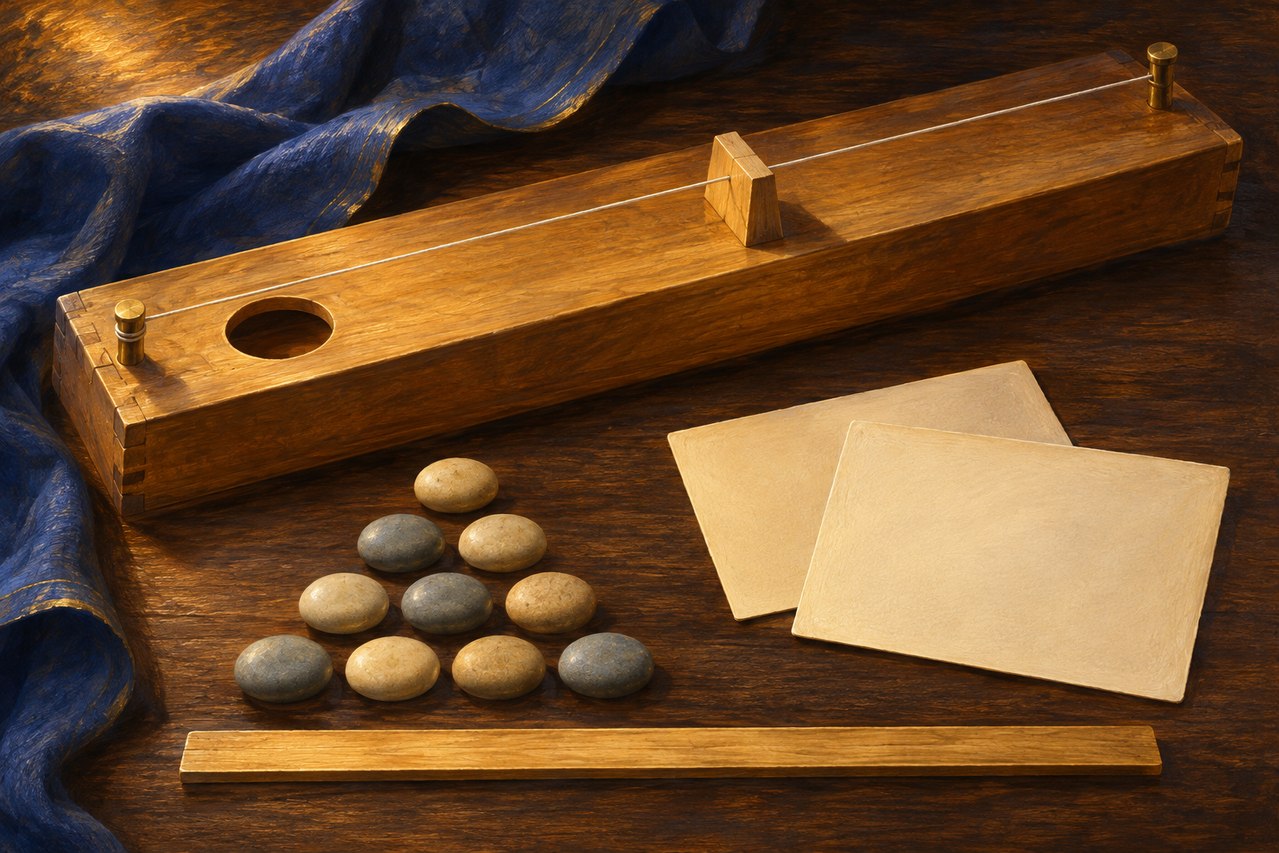
The linked NRICH resource supports the mathematical construction; the two Stanford entries discuss Pythagorean evidence and musical relationships; Aristotle supplies a primary ancient account read here with its critical context. The counter experiments and planning analogy are original editorial exercises. Both illustrations are newly generated conceptual artwork, not mathematical diagrams or historical reconstructions. For another form of numerical arrangement, read Magic Squares: When Numbers Become Symbols. For questions about modern calculation conventions, see name numerology across languages, or explore our Tarot Guides.