
Tarot Symbolism & Art
Temperance: Pouring, Restraint and the Art of Waiting
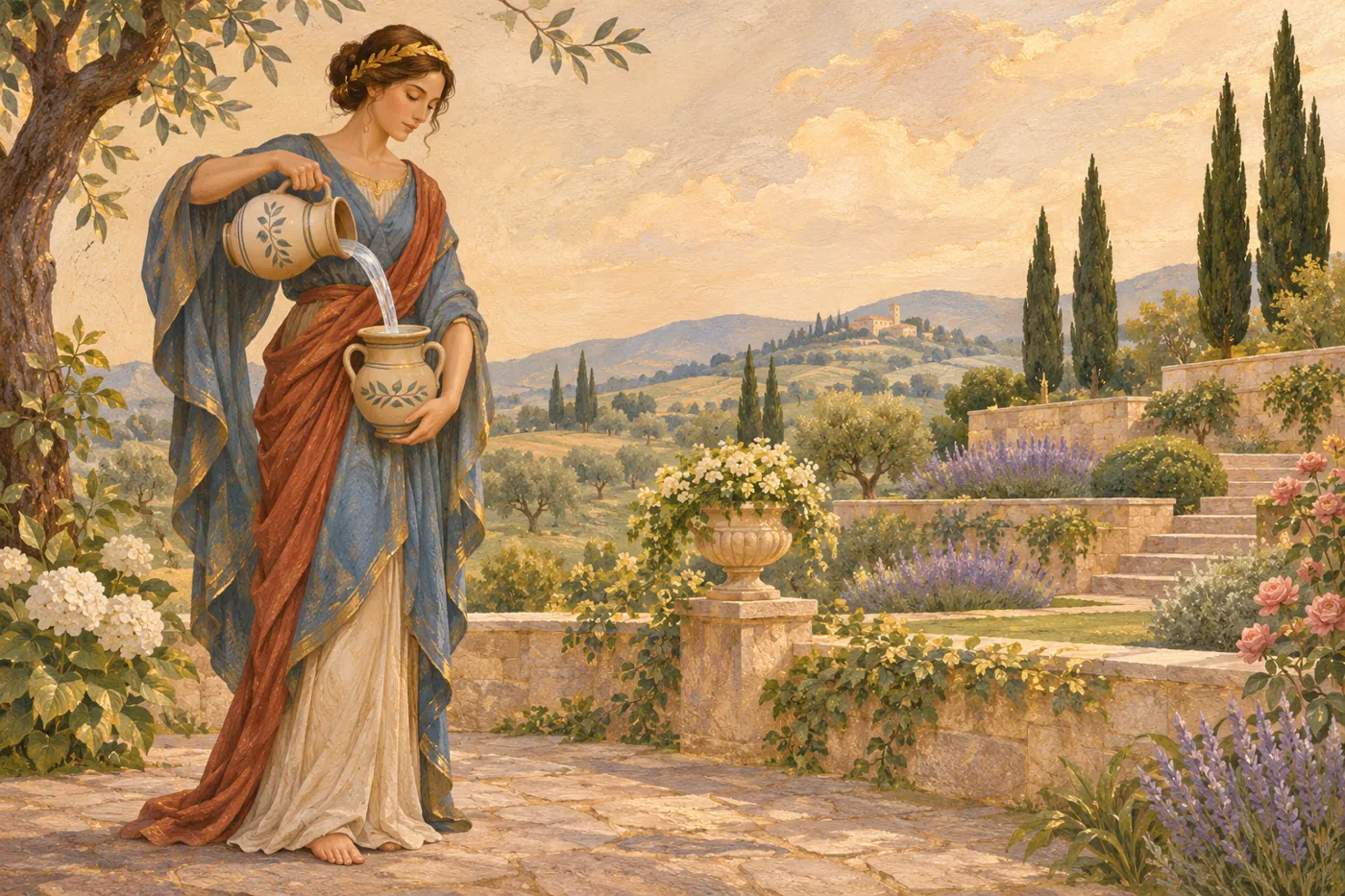
Temperance is often reduced to a reassuring word: balance. The image can be far more interesting. A person raises one vessel above another and attends to a narrow stream. Elsewhere, an artist gives the same virtue a bridle, a clock or an elephant. These objects turn an abstract quality into something visible. Following their differences helps us read Temperance as an active problem of proportion, timing and restraint, rather than a promise that every conflict will settle into harmony.
The action between the vessels
Start with the hands. One vessel is supported, another tilted, and the space between them matters. As an editorial reading of the pouring motif, we might notice attention, a controlled amount and the possibility of stopping. None of those associations requires the liquid to become a magical substance. The everyday difficulty of pouring carefully already supplies a rich image.
The Morgan Library & Museum’s iconographic record for card M.630.5 identifies Temperance as a woman holding pitchers in both hands in a landscape. Its individual card page dates the work to about 1480–1500 and lists Milan as its place of origin. These details give us a particular object to consider, rather than an imagined single original that every later card must faithfully reproduce.
Even a familiar gesture deserves a second look. Are the vessels similar? Is the figure watching the stream? Does the surrounding landscape encourage stillness or movement? Those questions keep the artwork present. If we begin and end with a memorized keyword, we can miss the choices that make one version different from another.
A surviving card is also a historical puzzle
The Morgan’s larger catalogue record for the Visconti-Sforza cards adds a complication. It discusses later cards, including Temperance, traditionally described as replacements, while recording scholarly disagreement over their artists and whether they were replacements at all. The concise artist label on an individual page therefore sits beside a more qualified research history.
That does not make the card less valuable. It gives the reader two different kinds of information: what the picture shows, and what researchers propose about its making. We can be confident enough to describe the pitchers while remaining cautious about a workshop attribution. The image and its biography do not have to carry identical levels of certainty.
For anyone comparing decks, this is a useful habit. Write down the edition or museum object before explaining its symbolism. A later restoration, a modern redraw and an early painted card may preserve a recognizable motif while changing its details. A family resemblance is worth tracing, but it is not a licence to merge all versions into one timeless design.
What might be in the cup?
A Temperance print in the Library of Congress offers a careful description of another pouring scene. The catalogue dates it between 1540 and 1610 and attributes it to Niccolò Vicentino after Perino del Vaga. Its seated personification pours liquid from a chalice; the summary suggests that she may be diluting wine with water. The qualification matters: it presents a possible identification, not a laboratory result.
This opens a productive alternative to the word balance. Mixing changes a proportion. It does not necessarily create equal quantities, and the desired result depends on what is being made. A recipe, for example, can require a small amount of one ingredient and a larger amount of another. Equality and suitability are different ideas.
Applied reflectively to a card, this suggests a sharper question: what amount would serve the purpose? It might concern time spent refining an illustration or how much detail belongs in a first conversation. This is our contemporary interpretation of the motif, not a claim about the intentions of every historical artist. It also leaves room for a clear limit: some things should be kept separate rather than blended.
Temperance without the pouring
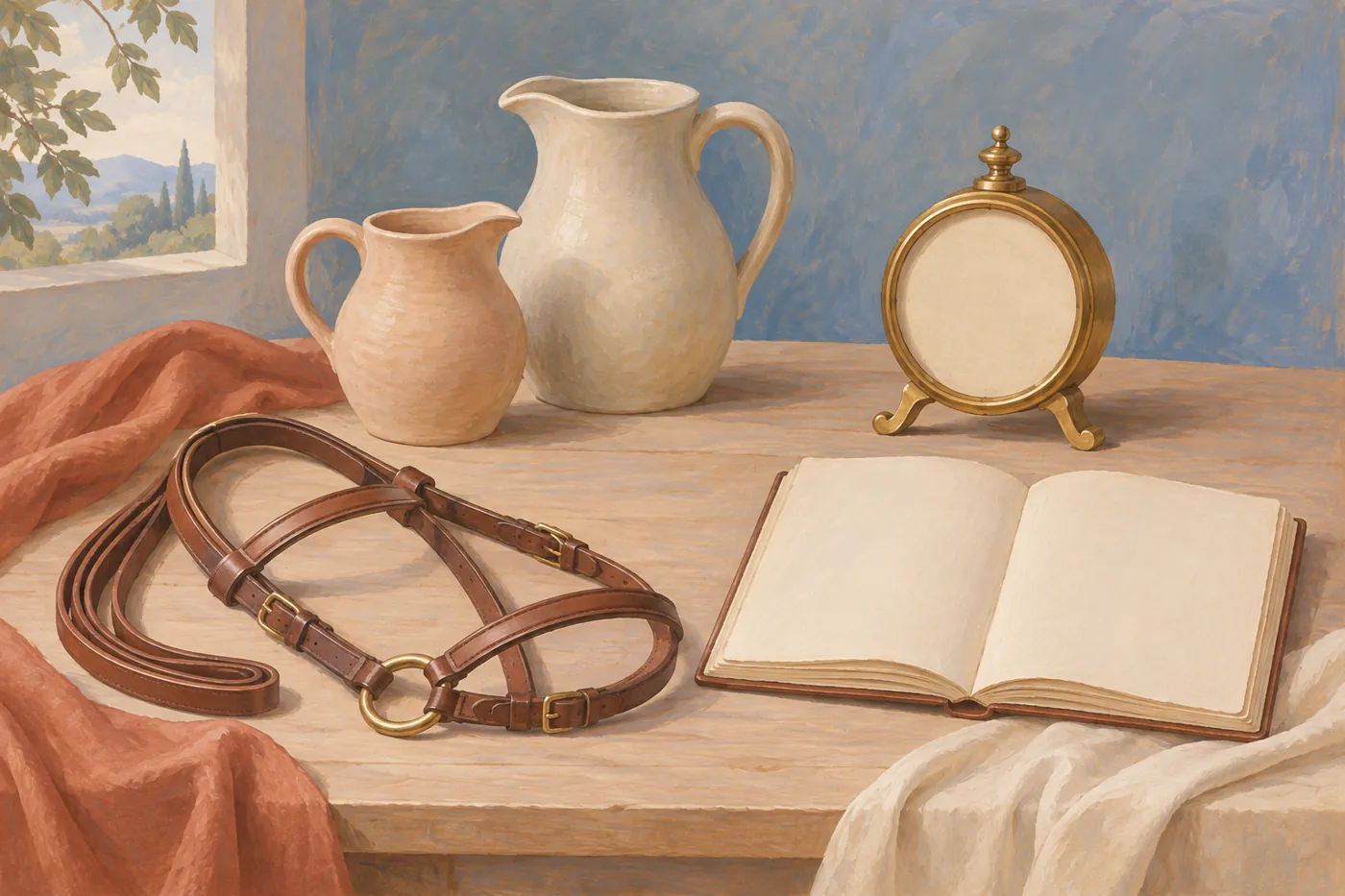
Luca Giordano’s Allegory of Temperance at the National Gallery widens the vocabulary. Made in the early 1680s as a study for the Palazzo Medici Riccardi’s ceiling decoration, it depicts an armoured woman leaning on an elephant. The Gallery identifies a bridle with restraint and a clock with patience; the elephant was regarded as both powerful and cautious.
Our comparison is that these attributes shift the emphasis. Pouring invites thought about quantity and combination. A bridle suggests directing an available force. A clock introduces duration: the right action may require waiting, repetition or an appropriate moment. The elephant makes strength part of the scene, so moderation need not be pictured as helplessness.
These are related possibilities rather than interchangeable definitions. Someone can wait patiently while refusing a compromise, or combine two ideas without delaying a decision. Looking beyond the cups helps prevent “Temperance” from becoming a vague instruction to accept whatever happens. The artwork invites us to name which quality is relevant instead of assuming they all mean the same thing.
A title cannot supply every missing detail
The Metropolitan Museum of Art holds a Temperance from a Tarot de Marseille, attributed to or after Jean Dodat. Its record identifies the medium as wood engraving and places it among prints, games or toys. At the time of research, that record offers no image. It is evidence of a catalogued card, but it cannot support a description of details we have not seen.
This is a small but consequential limit when reading online. A title may help locate an object without telling us its colours, posture or surrounding symbols. Filling those gaps from a familiar modern deck would quietly turn an assumption into a supposed observation. Better to leave the missing information open, then compare an accessible image with a clearly identified source.
Try a reading about proportion
For a practical exercise, take a Temperance card from a deck you own and choose one ordinary project. Identify the visible action that catches your attention before consulting the deck’s guidebook. Then set a question about a decision you can actually make: what needs a different proportion, what needs a limit, or what needs more time?
Imagine preparing a small exhibition. “Everything must be balanced” gives little direction. “The introduction is taking space away from the objects” identifies a proportion you can change. “We need a cutoff for new additions” identifies restraint. “The lighting needs another evening of testing” identifies time. These invented examples turn three visual associations into three different kinds of work.
Choose only the question that fits the evidence of your situation. A card does not establish another person’s motives or guarantee a successful result. Record the change you intend to try and what would count as improvement. You can later assess that choice through the project itself, while preserving the symbolic reading as the prompt that helped you formulate it.
Keep the gesture alive
Temperance becomes more useful when its objects remain specific. The pitchers ask about proportion; the bridle and clock offer other ways of imagining measured action. Historical examples show that the virtue could be pictured through more than one visual solution. Reading across them need not flatten those differences.
The next time Temperance appears, pause before writing “balance.” Look at what the figure is doing and ask what kind of adjustment your interpretation proposes. A richer reading can begin with a smaller, clearer question.
Sources and further reading
The six linked institutional records support the object descriptions and catalogue discussion. The comparisons and project exercise are original Precise Arcana editorial interpretations. Our two illustrations are newly generated conceptual artwork, not reproductions of the cited objects. Explore the Precise Arcana Temperance card and our Major Arcana guide for related reflective reading.