
Astronomy & Skywatching
The Leonids in 2026: What a Meteor Forecast Actually Promises
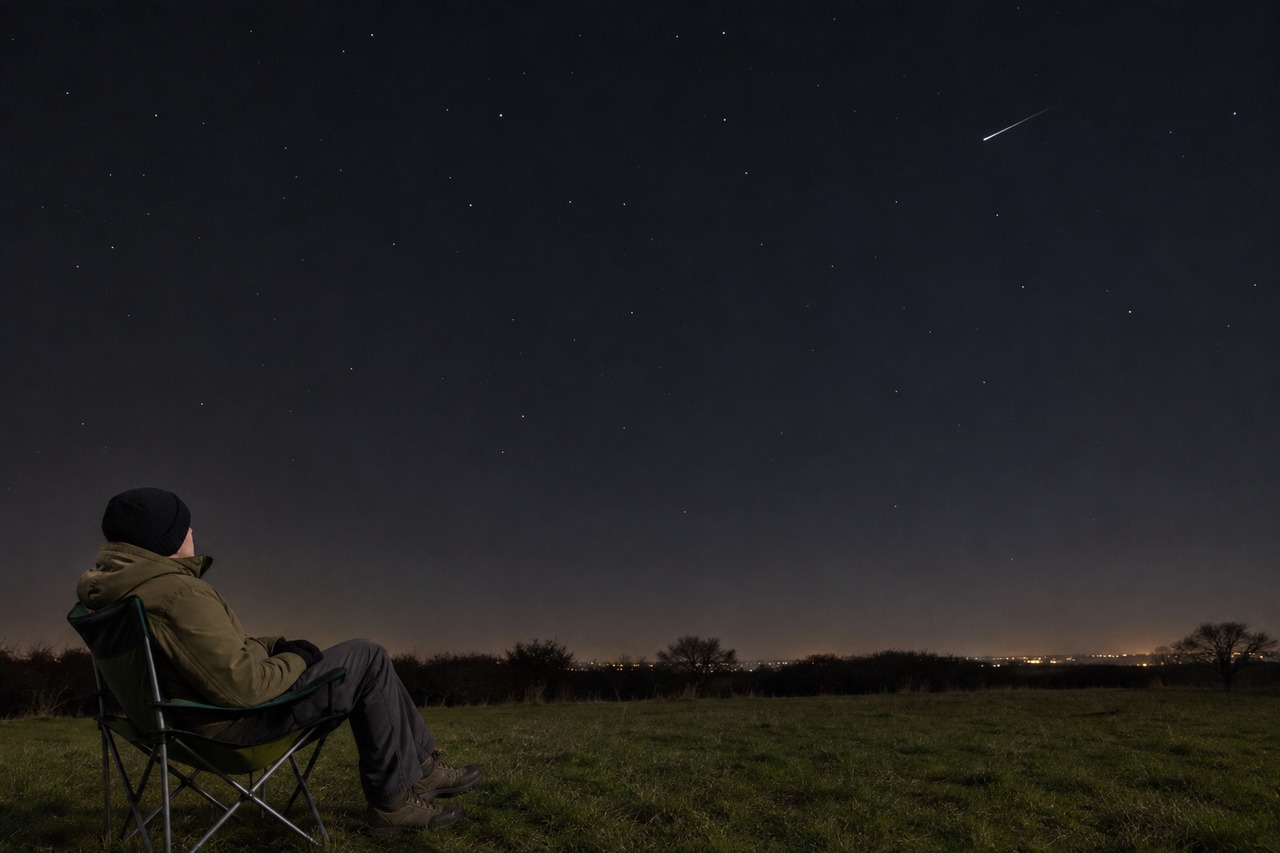
A meteor forecast can sound like an appointment: a named shower, a peak time and a number of meteors per hour. It is tempting to imagine the sky delivering that number as soon as the clock reaches the advertised minute. The approaching Leonids offer a better way to read such a forecast. Their November 2026 return invites us to distinguish a predicted feature of a debris stream from the view available to one person in a chair beneath a particular sky. The distinction makes an observing plan more useful, and a quiet night less misleading.
The light is nearby; the name points farther away
NASA’s introduction to meteors and meteorites separates the object travelling in space, the luminous event in the atmosphere and material that survives to reach the ground. A meteoroid produces a meteor when it enters the atmosphere; a surviving fragment is a meteorite. A shooting star is therefore not a star falling out of its constellation.
That vocabulary matters when looking at the Leonids. A name attached to a distant star pattern need not identify the material’s physical origin. NASA’s Leonid guide identifies the parent comet as 55P/Tempel-Tuttle. The visible streak is an atmospheric encounter with cometary debris, rather than light travelling from Leo to deliver a message.
You can enjoy the name and the sight without merging those explanations. “Leonid” identifies an astronomical shower. It does not establish a connection with someone’s natal Sun sign, and a meteor seen during November is not automatically a Leonid. Classification requires more than recognizing the month.
Read the dated forecast, including its qualifications
The International Meteor Organization’s 2026 Meteor Shower Calendar, edited by Jürgen Rendtel, lists Leonid activity from 6 to 30 November. Its Leonid section places the regular nodal maximum at 23:45 UT on 17 November 2026 and gives an approximate zenithal hourly rate, or ZHR, of 15. For ordinary clock planning in India, that listed instant corresponds to about 05:15 IST on 18 November.
The same section discusses a different model timing, 16:00 UT on 17 November, as well as possible weak encounters with low-density trails. The calendar is describing predictions with qualifications. Its most precise-looking time should not be promoted into a guarantee that every observer will experience the strongest display at that instant.
There is also a real difference between public resources checked for this story on 15 November: NASA’s Leonid overview labels the 2026 peak night as 16–17 November, while the dated IMO calendar gives the nodal maximum above. They should not be presented as unanimous. This article uses the IMO calendar’s explicitly dated calculation for its timing reference.
Keep that reference attached to the date. A saved note saying only “peak: 17th” loses the time standard and the forecast being cited. A useful plan distinguishes the published prediction, its local-clock conversion and the hours you can actually spend outside. The conversion alone does not establish local darkness, a clear horizon or suitable weather.
Fifteen per hour is not a personal quota
The IMO glossary defines ZHR using a standardized situation: one observer, a stellar limiting magnitude of 6.5 and the shower’s radiant at the zenith, directly overhead. Limiting magnitude describes how faint a star the observer can see. The quoted rate therefore comes with assumptions about the sky and viewing geometry.
It is not simply the number printed on a calendar divided into sixty equal minute-sized portions. An approximate ZHR of 15 does not promise a meteor every four minutes. A standardized rate and the timing of individual appearances answer different questions.
Consider an invented comparison. One observer has a broad dark view; another sits between buildings beneath a bright streetlight. Even if both use the same forecast, their opportunities to detect faint streaks differ. Reporting different totals would not by itself prove that either person counted incorrectly or that the forecast referred to different showers.
Do not try to repair this by inventing a precise local rate. Without the necessary observing information and an appropriate calculation, “you will see seven” is no better supported than “you will see fifteen.” The practical response is to describe the conditions and keep expectations flexible.
The radiant is a reference, not a target to stare at
NASA explains that Leonids can appear across the sky and advises looking beyond the radiant rather than fixing attention only on Leo. Close to the radiant, meteor paths appear shorter through foreshortening. The constellation provides a reference for apparent direction; it is not a small window containing the entire display.
The same guide recommends beginning around midnight local time, choosing somewhere away from streetlights, settling comfortably and allowing roughly half an hour for dark adaptation. These are general viewing suggestions, not a calculation of radiant rise or twilight for your particular address.
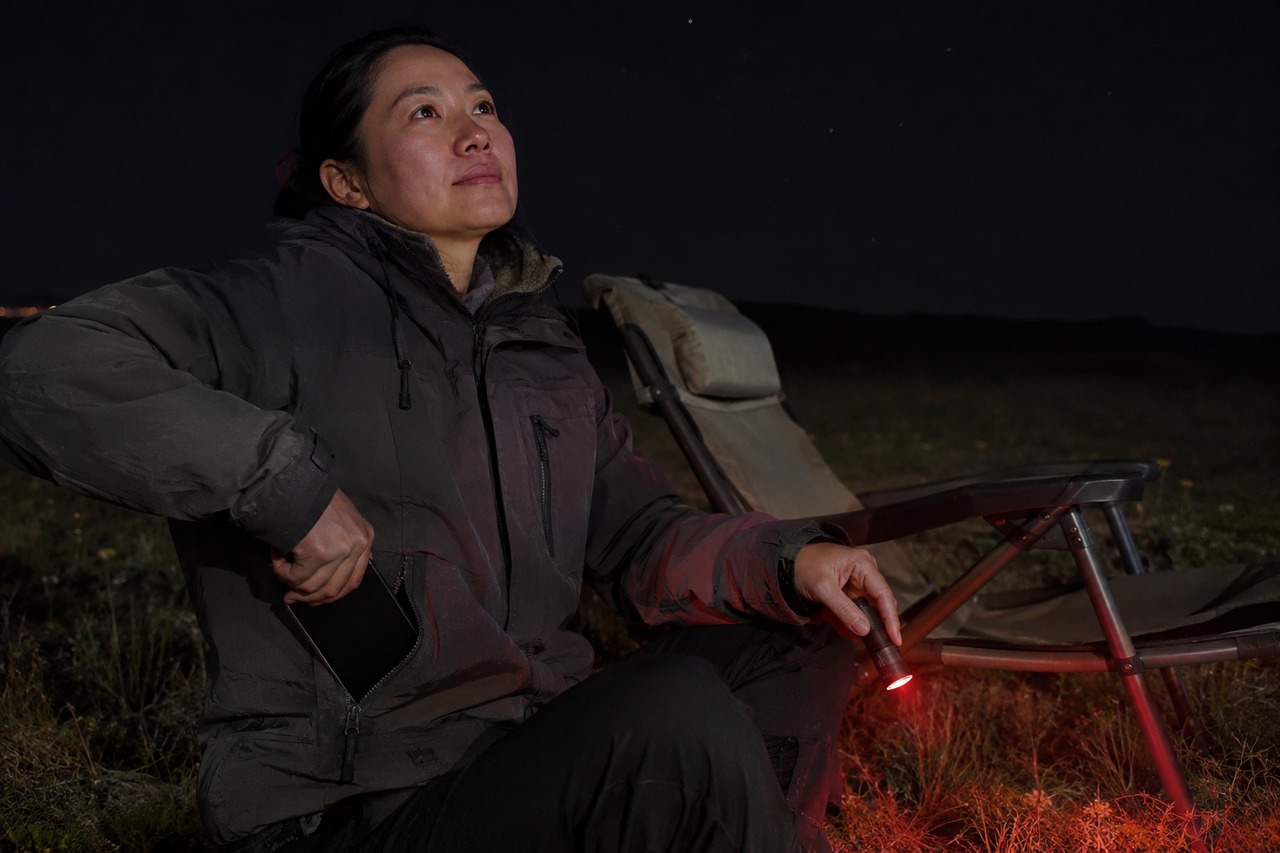
For a practical outing, settle on a permitted, accessible place with an open view before darkness makes unfamiliar ground difficult to assess. Check your local forecast and the time you need to return. A comfortable chair and suitable clothing can make sustained attention easier; an impressive telescope is not the point of this naked-eye activity.
Record the time you watched, not just the time you arrived
The IMO’s visual-observation guidance asks potential observers to watch for at least an hour and emphasizes that activity contains quieter and busier intervals. It also discusses the loss of observing time when someone looks away to write, and the use of audio recording to preserve attention to the sky.
The guidance distinguishes shower members from sporadic meteors and records conditions such as limiting magnitude. Those requirements explain why a casual tally and a standardized observing report should not be treated as equivalent. This article’s suggestions are an introduction, not a substitute for learning the full reporting method.
For a personal outing, begin with three modest notes: where you were, the interval you actually watched, and anything obstructing the view. If you pause to check a phone or go indoors, mark the interruption. An hour between arrival and departure is not necessarily an hour of watching.
Keep uncertain identifications uncertain. “A brief streak seen toward the south” can be an honest description even when you cannot confidently assign it to a shower. A remembered impression does not become a measured trajectory merely because a calendar supplies a convenient name.
Putting a bright screen away also serves the experience itself. The goal is to attend to a wide, changing field rather than repeatedly checking whether the advertised event has started. Both generated images in this story reconstruct imagined observing situations; neither documents a Leonid sighting or a calculated sky for November 2026.
A quiet watch can still be a worthwhile encounter
A forecast helps us decide when to look. It cannot do the looking for us, and it cannot guarantee a memorable event within the minutes we choose. The Leonids are a useful occasion to practise that distinction: retain the source, understand the rate, make a local plan and report what actually happened.
If you use skywatching as a reflective practice, let the reflection follow the observation. Waiting might suggest a question about patience or expectations. That is a personal association, not evidence that a meteor has announced a change in your career, relationships or luck.
The sky does not need to meet a quota to reward attention. A single streak, an uncertain glimpse or a clear view with no meteors recorded can each belong in an honest account. What makes the account useful is the care with which the expectation and the experience remain distinguishable.
Sources and further reading
The five linked NASA and IMO resources support the physical definitions, forecast, rate terminology and observing guidance. The comparisons and personal note-taking suggestions are original editorial analysis. Images are original AI-generated photographic-style illustrative reconstructions, not astronomical evidence. Continue with phase and local Moon visibility, or explore our Tarot Guides for reflective practices.