
Tarot Symbolism & Practice
Justice: Who Holds the Scales?

A pair of scales invites us to compare. A sword asks what happens after the comparison. Held together by Justice, these objects make a more demanding picture than a promise that everything will work out fairly. Someone must decide what belongs in the pans, how to judge the result and what action to take. Looking closely at that responsibility gives the card a useful place in a reflective tarot practice, without turning it into a verdict about another person or a forecast of a court decision.
Recognisable objects, different kinds of work
The scales and sword belong to a visual language larger than tarot. The Metropolitan Museum of Art holds Marcantonio Raimondi’s engraving of Justice from The Virtues, dated approximately 1515–25. Its catalogue identifies a woman with a raised sword and scales, and describes the composition as possibly after Raphael. It is an engraving, not a playing card.
That distinction is useful. A familiar combination of attributes can move between kinds of images. Finding it in a print provides a concrete comparison; it does not establish that this particular print supplied a tarot design or that every artist understood the objects identically. Keep the museum’s qualified attribution intact rather than turning “possibly” into certainty.
For this article, the two objects suggest two activities: comparing and committing. That pairing is an original reading exercise, rather than a claim to recover a single secret intention behind the historical imagery. It lets us ask what we actually do when we say a choice has been weighed.
Who chooses what goes in the pans?
Start with the scales. In the header illustration, an imagined demonstrator points towards the pivot of an equal-arm balance. Matching weights occupy the pans. The scene makes comparison tangible, but it also draws attention to the apparatus that makes comparison possible.
A balance cannot decide which things deserve to be compared. Nor can it tell us whether the objects placed on it represent the question we meant to ask. A level beam is informative within the conditions of the demonstration. It does not settle an argument about fairness.
Bring that distinction into a reading. Suppose you are dividing work with a collaborator. Counting tasks might produce an equal number on each side. Yet one task could require a whole afternoon while another takes ten minutes. You might need to compare time, difficulty, responsibility or access to resources. Choosing the unit of comparison is part of the decision.
Justice can therefore prompt a better question than “Am I getting my fair share?” Try “What am I counting as a contribution, and have we agreed on that measure?” The second wording creates something the people involved can discuss. It also leaves room for information you do not yet have.
This does not mean all competing claims deserve identical weight. An observable commitment and an unsupported suspicion are different kinds of material. Before balancing them in your mind, identify which is which. The card can direct your attention to that sorting; it cannot supply missing evidence.
Waite’s distinction between two similar settings
In his discussion of Justice in The Pictorial Key to the Tarot, Arthur Edward Waite notices that the figure sits between pillars, as the High Priestess does. He then distinguishes the moral principle of receiving according to one’s works from a different, mysterious spiritual order. The architectural resemblance does not make the two cards equivalent in his account.
That is a useful example of an author resisting a purely visual shortcut. Two pictures can share a setting while directing their readers towards different ideas. For a contemporary reader, the practical lesson is to examine a resemblance and then check the accompanying text, rather than importing the whole meaning of one card into another.
Waite’s theological explanation belongs to his own interpretive framework. It need not become a claim that everyone’s present circumstances are deserved. Reading Justice responsibly leaves room for unequal conditions, incomplete knowledge and experiences that cannot be reduced to a simple reward-and-punishment story.
The sword brings a decision into the picture
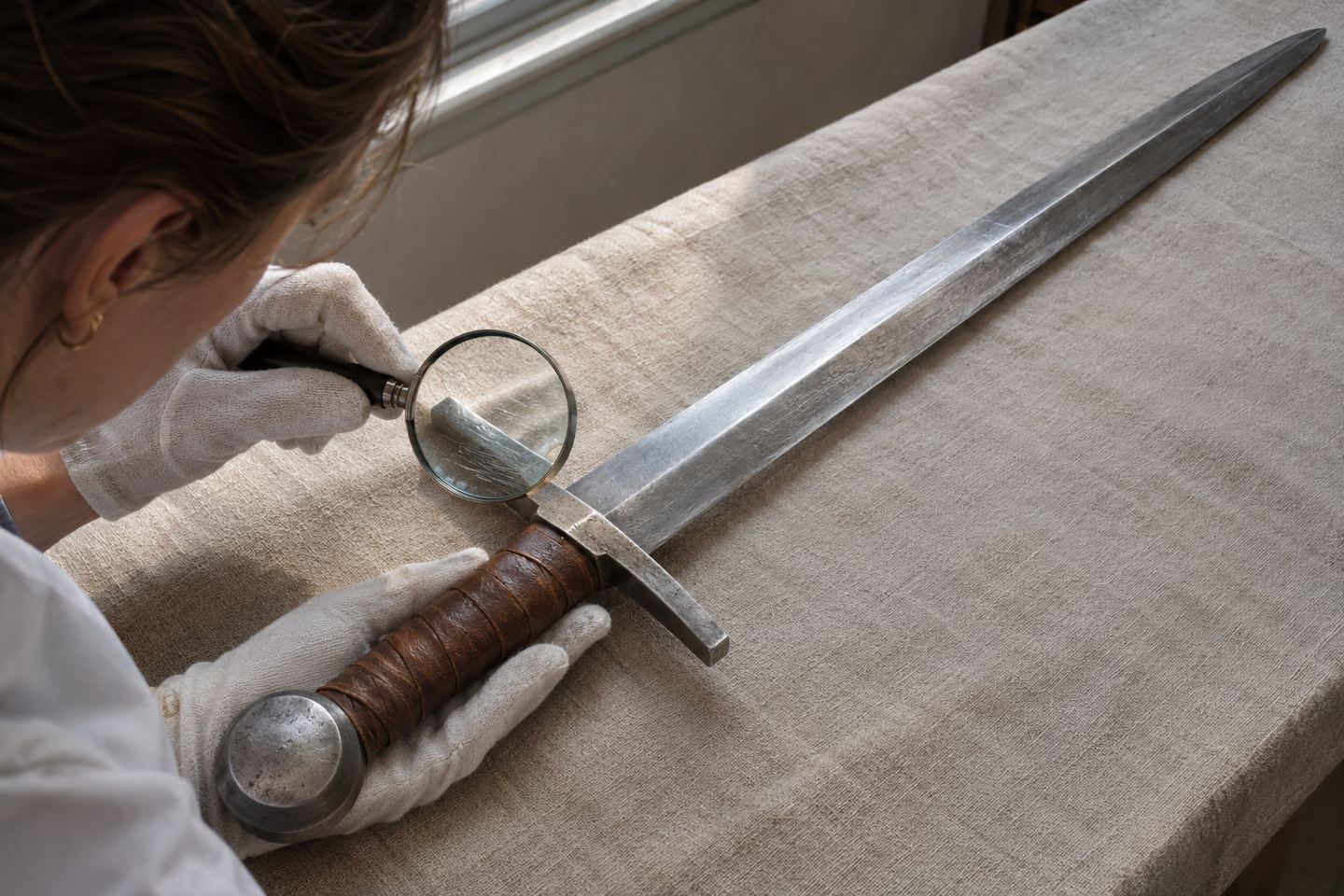
The sword introduces an object with a different purpose from a measuring instrument. Our section illustration shows an imagined examination of a modern replica, keeping the blade and hilt visibly connected. It is a study of the attribute, not a reconstruction of a particular historical sword or proof of how tarot cards were made.
As a reflective association, the sword can suggest the point where a comparison becomes a boundary, an answer or a commitment. A decision usually changes what happens next. That makes its consequences part of the reading, rather than an afterthought.
Return to the shared project. After discussing the workload, you might agree that one person completes a smaller set of more demanding tasks. The useful next step is to record who will do what and when you will review the arrangement. Continuing to weigh the same concerns indefinitely could leave both people without a workable agreement.
There is also a difference between clarity and severity. A precise response can be proportionate: revise a deadline, acknowledge an error, ask for clarification or decline an additional task. Nothing about the presence of a sword requires imagining punishment or confrontation. That is our application of the symbol, not a rule that every tradition must follow.
Reading an old keyword list without making a prediction
Waite’s separate list of Greater Arcana divinatory meanings connects Justice with fairness and integrity, but also includes a favourable legal outcome for the deserving side. His reversed entry includes prejudice and undue harshness alongside legal complications.
Those are documented meanings allocated within his divinatory system. Quoting or paraphrasing the list does not establish that a card can identify a deserving party, reveal an absent person’s motives or determine the outcome of proceedings. A historical meaning and a reliable factual conclusion are different things.
For reflection, the reversed associations can become questions about the quality of your own process: Have I heard only one account? Am I applying a rule selectively? Would my proposed response be harsher than the situation warrants? You can ask these questions without declaring someone else guilty or assuming that a reversed card announces misfortune.
A single-card exercise with a review point
Select Justice deliberately for this exercise. This is a study of a chosen image, not a random draw presented as a prediction. Pick an ordinary, manageable decision such as agreeing a project deadline. Write four short notes:
- The comparison: What two or more claims, needs or options am I weighing?
- The measure: What standard am I using, and would I accept it if our positions were exchanged?
- The response: What specific action can I take within my responsibility?
- The review: What new information would justify changing that response?
Keep an observation separate from your explanation of it. “The draft arrived two days after our agreed date” is different from “My collaborator does not respect my time.” The first statement can be checked against the agreement. The second makes a claim about motive that may need a conversation.
Likewise, avoid making the review point another demand for certainty. You could agree to check the new schedule after the next milestone. That creates an opportunity to learn from what happens without requiring the card to certify the decision in advance.
Hold the two objects together
Justice becomes more interesting when the scales do not stand for endless deliberation and the sword does not stand for automatic punishment. Comparison asks for an explicit measure. Commitment asks for a response you can explain and revise when warranted.
For a deck-specific starting point, explore the Justice card page. Our guide to asking tarot questions can help turn a verdict-seeking prompt into a question about your own choices. A careful reading ends with a clearer account of what you know, what you still need to ask and what you are prepared to do.
Sources and illustration notes
The linked Met collection record supports the comparison with a sixteenth-century engraving. The two linked sections of Waite’s book supply his symbolic discussion and historical divinatory meanings. The project example and four-note exercise are original editorial suggestions. Both images are original AI-generated photographic-style illustrations of imagined modern demonstrations; neither depicts a museum artifact, an identified conservator or a documented event.