
Tarot Symbolism & Practice
The Hermit: What Changes Between an Hourglass and a Lantern?

A lantern and an hourglass can both be carried in one hand, but they do different work. One makes something visible; the other makes an interval perceptible. When an elderly figure carries either object in tarot, the difference deserves more attention than a single keyword such as solitude. Comparing the objects gives us a way to ask whether a reading concerns time passing, knowledge shared, or a decision that needs a clearer view.
Begin with a card actually called Time
The Morgan Library & Museum catalogues a Visconti-Sforza card under the title Time. Its individual record gives Milan, about 1450–1480, and the reference MS M.630, number 10. That collection number identifies the object; it should not be mistaken for a universal tarot sequence or a modern card number.
The museum’s explanation of the image identifies an elderly man whose beard and bent posture express age, while the hourglass refers to time passing. We do not have to imagine a concealed lamp to make the image meaningful. The object already supplies a distinct action: material moves from one compartment to another, and an interval takes visible form.
Our comparison starts there, rather than with a claim that every later Hermit contains exactly the same message. An old figure with a timing device and a figure raising a light can resemble each other while directing attention toward different problems. Historical continuity is a question to investigate, not permission to ignore a changed attribute.
An hourglass measures an interval, not an appointment
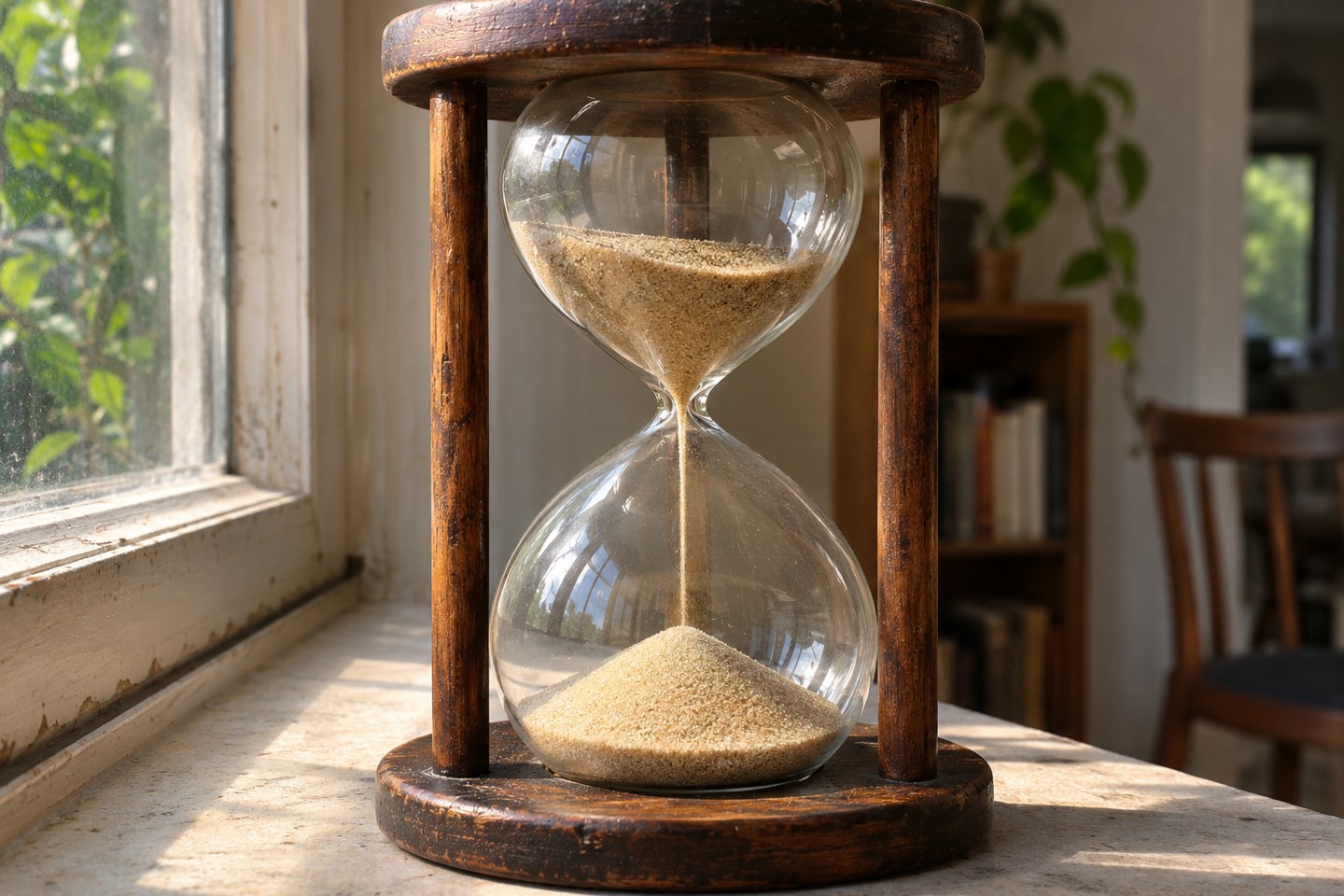
Imagine watching sand collect in the lower bulb. You can see that a process is underway. Yet without knowing the device’s calibration and when it was turned, its appearance cannot tell you the current clock time. The distinction matters even more when the hourglass is a painted symbol rather than an instrument in use.
In a reflective reading, it might prompt questions about duration: what takes repeated effort, what has an ending, or what changes while we wait? Those are editorial possibilities, not measurements extracted from the card. Nothing in a pictured hourglass establishes that a message will arrive in nine days or that a project will succeed next month.
Consider preparing a portfolio. There is a difference between allowing time for a difficult drawing and postponing sending any work indefinitely. The hourglass metaphor can help articulate that difference, but the practical decision still needs a calendar, a workload estimate and an honest view of what remains unfinished. A symbolic interval becomes useful when connected to an observable task.
Waite’s lantern is not simply a private retreat
A different emphasis appears in A. E. Waite’s The Pictorial Key to the Tarot, in the section on the Hermit. His account describes a star within the lantern and a figure raising a beacon from a height. He interprets the scene through attainment and the possibility that others can reach a similar point. He also explicitly argues against an explanation based on occult isolation.
This is evidence for Waite’s stated interpretation, not proof that it governs every deck or that his spiritual claims are established facts. It is useful precisely because it complicates the familiar habit of making the Hermit mean “avoid everyone.” A raised light can be addressed to another person. Being physically alone in an image does not settle what relationship the image proposes.
For a contemporary reader, the contrast offers another question: what knowledge could be made available? That might involve explaining a process, showing someone where to begin, or acknowledging the limits of your own experience. Guidance can be specific and modest. It need not require becoming an unquestionable authority.
Do not turn a comparison into a tidy origin story
It is tempting to arrange the two objects into a simple tale: first tarot meant time, then it discovered wisdom, and finally it became what we use today. Two examples cannot establish that sequence. They show different visual and interpretive choices in particular documented settings. A comprehensive history would require many more surviving cards, editions and texts.
The V&A’s overview of tarot history places cards within changing uses, from games to later divinatory practice, and identifies Pamela Colman Smith as a designer of the influential Waite-associated cards. Remembering the designer also keeps us from treating an illustrated deck as a transparent window into one author’s prose.
When you compare your own cards, record the deck, artist and edition if known. A reproduction can change colour, crop a staff, or make a small object harder to distinguish. If the object remains unclear, write that down instead of deciding what it must be from a familiar keyword. Uncertainty can remain part of the description without preventing a thoughtful response.
Try three questions with one ordinary project
Choose a project whose next step is within your control. Look at the Hermit in your deck before opening its guidebook. Describe the visible object and gesture in one sentence. Is something being lifted, concealed, carried or watched? Keep that sentence separate from what you later infer.
Then try three prompts. The first concerns duration: what part of this project needs a defined period of work? The second concerns visibility: what information would make the next decision clearer? The third concerns guidance: who could offer a specific demonstration, or what could you explain to someone else? These prompts are alternatives to test, rather than three compulsory meanings.
Suppose you are learning to photograph a handmade object. Duration might mean setting aside an afternoon for lighting tests. Visibility might mean comparing two test photographs at the same size. Guidance might mean asking an experienced photographer to explain one camera setting. Each answer leads to a different action; none follows automatically from drawing the Hermit.
Finish by choosing one small step and a way to assess it. After the afternoon, did the comparison make the surface easier to see? Did the explanation help you repeat the result? The outcome belongs to the work you actually performed. Keeping that distinction allows the card to stimulate a useful question without pretending it certified the answer.
A light can connect people
The strongest lesson in this comparison is not that one object replaces another once and for all. It is that objects direct attention. The hourglass makes duration a visible problem; the raised lantern introduces visibility and the possibility of guidance. Reading carefully means allowing those differences to survive our urge to summarize.
The Hermit need not become an instruction to withdraw from help or to trust every solitary conviction. Ask what your chosen image actually shows, which interpretive tradition you are using, and what practical question follows. A smaller, better-defined question can illuminate more than an impressive prediction.
Sources and further reading
The linked Morgan records, Waite text and V&A overview support the historical comparison. The portfolio and photography examples are original reflective exercises, not predictive claims. Both images are original AI-generated photographic-style illustrations: a staged modern lantern scene and a generic hourglass demonstration, not photographs of historical events or collection objects. Continue with the Hermit card or our Major Arcana guide.